

Englewood Center for the Arts is excited to present Ceremonies of Form, a retrospective exhibition celebrating Sarah Riley’s remarkable journey as an artist. The opening reception kicks off on Saturday, November 7, from 4 to 7 p.m. This show doesn’t just display her work. It draws you into a vivid world where symbolism and transformation collide. This is an exciting opportunity to meet Riley in person and see her art up close.

Sarah Riley’s career stretches across decades and disciplines: painting, ceramics, mixed media, and more. She spent years as Chair of Printmaking at Southeast Missouri State University, where she also taught drawing and design.
Her art springs from sources as varied as mythology, art history, absurdist theater, and the living landscape. Riley is fascinated by the ways memory, identity, and dreams overlap and reshape each other. This November, Ceremonies of Form offers a window into that lifelong search for meaning and beauty.
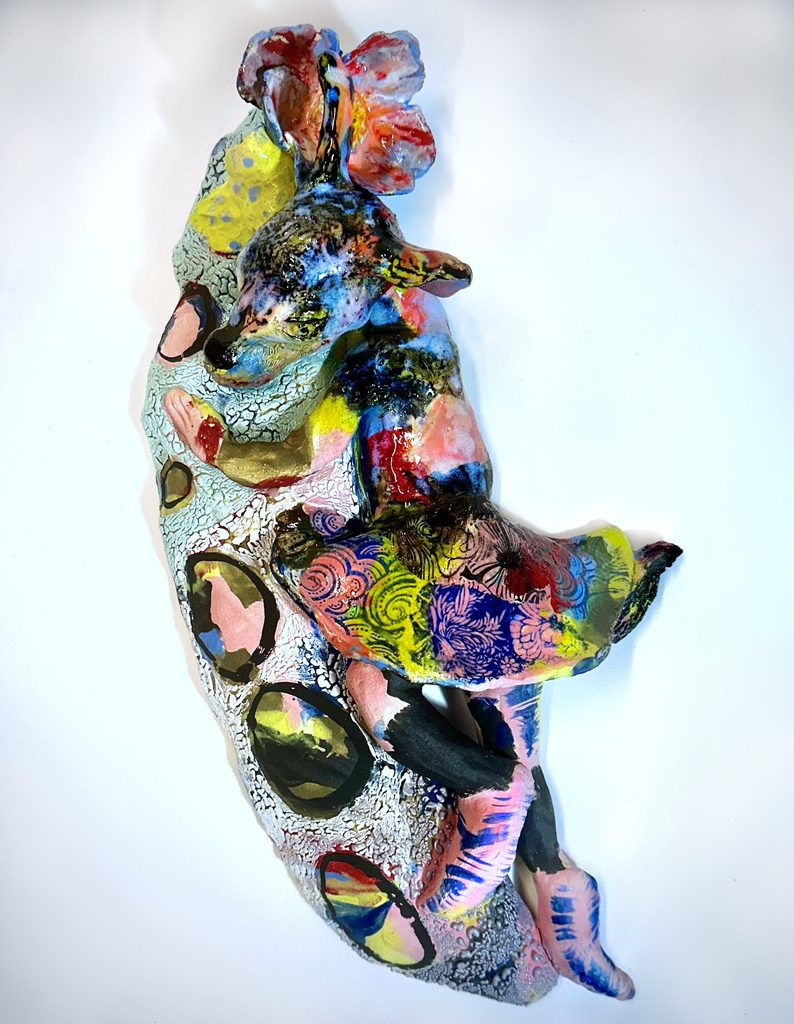
Sitting down with Sarah, we explored her path to Englewood, how her experiences shaped her art, and where she finds her inspiration.
When asked about her teaching career, Sarah reflects, “I was at Southeast Missouri State from ‘94 until I retired in 2014. Before that, I taught at Stevens College in Columbia, Missouri—though I grew up in Virginia. I got my start at Virginia Commonwealth University in Richmond. My first husband’s PhD in art history drew us out to Missouri. We spent a few years in Italy while he worked on his dissertation. Eventually, he took a job at the University of Missouri in Columbia. I taught as a TA there, went to grad school, and then landed a job as an assistant professor at Stevens College. They promoted me to department chair pretty quickly.”
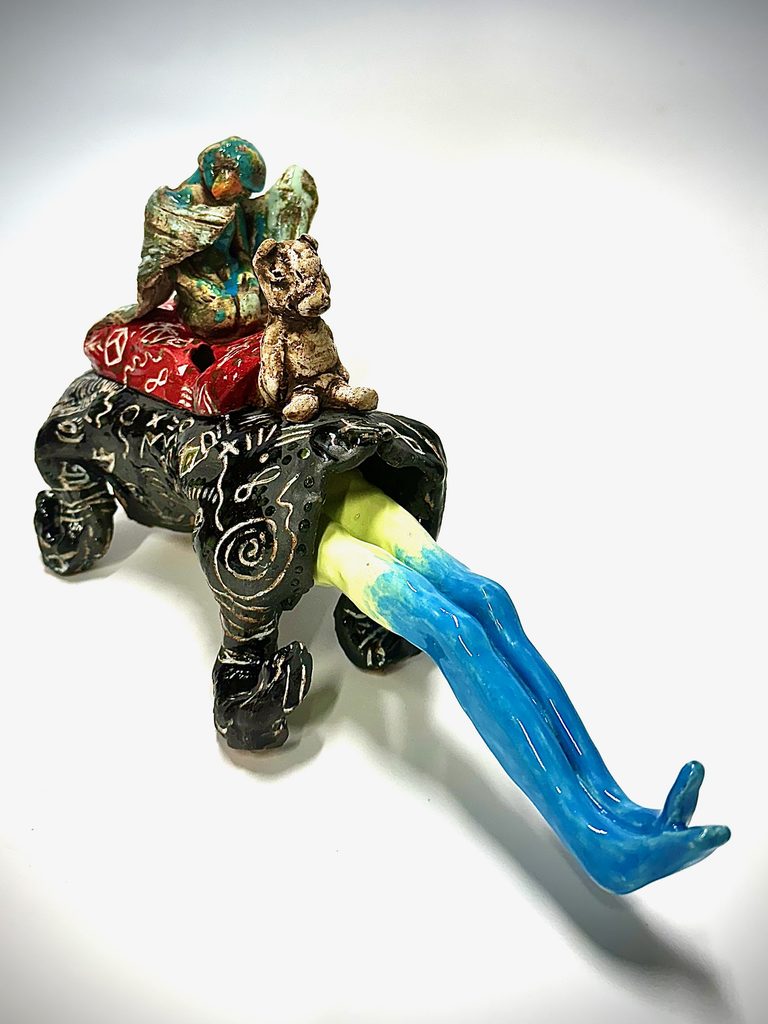
After twelve years at Stevens, Sarah sought new opportunities, driven by the need for better pay and with two young children at home. “That’s when I joined Southeast Missouri State, at the Holland School of Visual and Performing Arts, or at least that’s what it was called when I left.”
The Path to Englewood
“That was a long journey,” Sarah explains. After a few moves post-retirement, Sarah’s husband couldn’t take the cold. “We started looking for a warmer place in Southwest Florida, and eventually found Englewood—south of Sarasota, where the prices were (surprisingly) reasonable. Our little cottage was beautiful, surrounded by old trees and next to Lemon Bay Preserve. Then, Hurricane Ian hit, took most of those trees, but we were determined to find somewhere cooler for the summers. We sold our Cape Cod house, bought a place in Highlands, North Carolina—right on a lake. But hurricanes, as we learned, follow you everywhere. We sold our North Carolina place just a month before Hurricane Helene hit. Now, we’re settled here in Port Charlotte, right near Englewood, and this is home.”
Sarah’s work is described as drawing from mythology, art history, absurdist theater, and the natural world. Asked how she weaves absurdist theater into her art, she mused, “It’s about the madness of the world. Absurdist theater—think Brecht—shines a light on the insanity and contradictions of life. Everything’s a dichotomy. You flip something over, and it becomes something else entirely.”

She describes one particular piece: “There’s this squawking bird that morphs into ballerina legs on one side; on the other, it’s a rabbit. All parts of one creature. It can be hilarious, tragic, or beautiful—a mix of all three, really.”
Is she still working on pieces for the show?
“Oh yes. I shipped a lot of work to New York, so I’m racing to make new ones for this exhibition. Some of these pieces have never been seen before.”
Where does her inspiration come from?
“I think it’s the act of experimenting. It’s listening to what the materials want—being open to intuition. Sometimes, I don’t even know what I’m making at first. Clay is so suggestive. You start with one idea, but maybe suddenly it needs a rabbit’s head instead of an ear, so you follow that impulse. The beauty of this area—or what’s left of it without relentless development—feeds into my work.”
Can you describe your process?
“While everyone else chats, I’m locked into the world of ‘What comes next?’ Getting lost in the making—it’s almost hallucinogenic, but no, no drugs involved!”
Spending time in Italy had a profound effect on Sarah. “There’s the myth of Daphne—Bernini sculpted her as she escaped Apollo, turning into a laurel tree. That struck me while I was working on a piece: legs turned into a log, a tree stump, leaves everywhere. It connects the ecology here and Greek myths. Another recent work features a Selkie, shedding her skin—a Celtic myth, but she didn’t start out that way. As the textures evolved, she looked more aquatic. Memories of the myth came rushing back. Absurd, maybe, but definitely transformative.”
“I studied a lot of fifteenth-century Italian art—Piero della Francesca, Agostino di Duccio, those sculptures. The beauty stays with me. When I work on a hand or foot, the influence comes through, especially in figure drawing. That was my favorite class to teach; it’s substantial, tangible. I’ve always been drawn to three-dimensional form. My undergraduate was in sculpture. It took ages to circle back after painting, drawing, printmaking, then teaching all those things. My fascination with the human figure comes straight from studying Italian sculpture and painting—Tintoretto, Francesca—somehow, all that’s in the mix.”
For more information about Englewood Center for the Arts call (941) 830-6690 or englewoodart.com.