
Funding for Florida’s arts education continues to shrink. Florida schools are experiencing another complicated year for 2025–2026; while multiple state grants are back, they’re not enough. At the local level, arts and music programs are still being squeezed. School budgets are tight, especially when enrollment drops.
Teaching artists, educators who teach children each day how to play instruments, face the greatest challenges. Nonprofits are scrambling for private donations just to keep these programs alive.
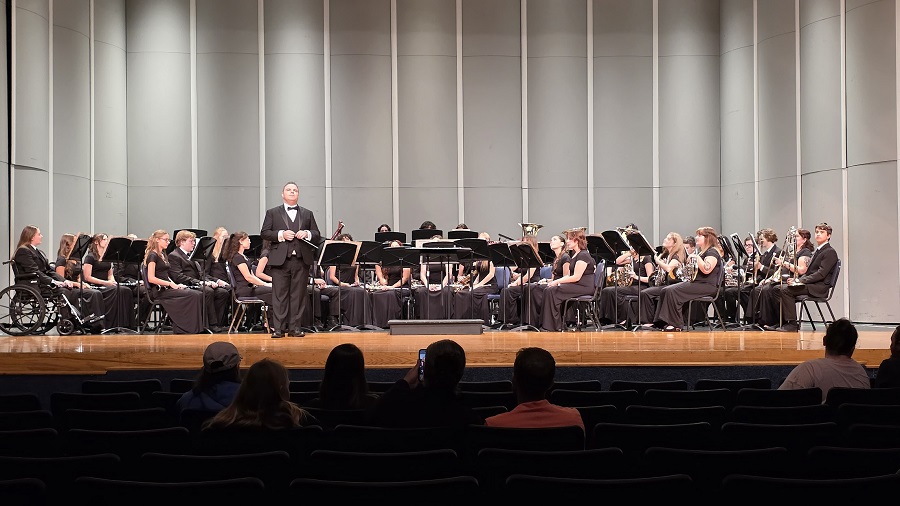
Lemon Bay High School Symphonic Winds
Losing school bands and instrumental music programs is tough on everyone. But not every story is grim. Lemon Bay High School’s instrumental music program is still going strong.
At the FBA District 11 Concert Band Music Performance Assessment, Lemon Bay’s Symphonic Winds pulled off another clean sweep: straight superior ratings, again. Ten years running. That’s a decade of students walking onto that stage, giving their all, and making the school and the entire community proud.
You don’t get results like that by accident. It takes relentless hard work, hours of practice, student leaders who set the pace, and families who never stop supporting from the sidelines.
What’s really impressive? It’s not just the same group year after year. New students step up, learn from those before them, and set an even higher standard. Every class honors the tradition, then pushes for more.
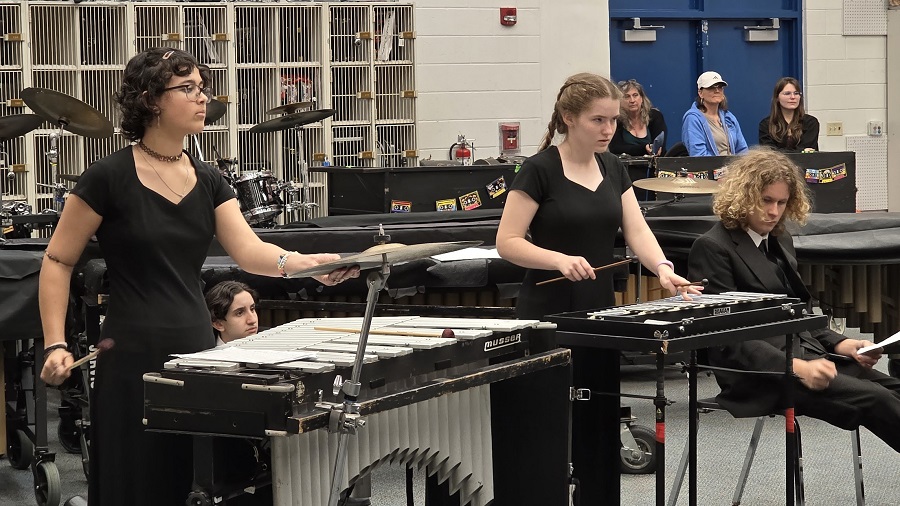
Englewood REVIEW sat down with Mr. Eyrich, the director of Lemon Bay High School’s instrumental music program:
ER: Mr. Eyrich, Congratulations on ten years of superiors, that’s wonderful.
Mr. Eyrich: Thank you.
ER: How long have you been the band director at Lemon Bay High School?
Mr. Eyrich: This is my ninth year at Lemon Bay.
ER: You must be so proud. How do you feel about all of this? Ten years of superiors, what does that mean to you all?
Mr. Eyrich: Well, it’s certainly a big accomplishment and it reflects the hard work of hundreds of students over that time period, and their commitment. Once they’re in here, they work really hard, and we’ve had a lot of consistency. At the end of the day, it’s taking small steps toward a goal over a long period of time.
ER: Tell me about the students. Sometimes you can chalk up success to, “Okay, we had this really great group this year.” But ten years of superiors, that comes down to great leadership.
Mr. Eyrich: The students come from all backgrounds, right? So you’ve got some kids who are going to make the All-State band and then you’ve got some kids who might not be the best players but they’re good section players. It takes all kinds of kids, and I think the biggest thing is the working together and the mentorship that we have in the program. It’s really something to see.
I’ve got a great feeder program, his name’s Tim Ostrow over at L.A. Ainger Middle School. He’s a big part of this because he gets the kids fundamentally very well prepared. He does a lot of the fundamental teaching, and we do a good deal of that here in high school.
But once they get here, you’ve got kids who know how to play their instruments already at a high level and they organize their own section rehearsals outside of class. I’m always seeing kids working together in the band room trying to get better at the music.
I would really say that a big part of the success is that the students have really taken ownership of the band program. That’s a huge deal because if they don’t want to do it, then they’re either going to not do it anymore, they’ll just quit, or they won’t be as responsive and they won’t work as hard.
I see the students taking ownership and helping each other out, without even needing to be asked. They go above and beyond my expectations. They ask me, “Hey, we want to stay after school for a couple of hours and really work on this.” The initiative that takes is something special, and I think they know what’s at stake every year, that they’ve got this tradition of excellence that they’ve established, and they want it even more than I do in some cases.
ER: I love what you said about the teamwork, that not everyone’s the star player, but that doesn’t mean that they can’t be an important part of that section. I love that you have that attitude and you share that message with them, because you don’t have to be a superstar to be a part of the team, to be a part of the band.
Mr. Eyrich: Of course, and that’s really one of the things that sets us apart from something like athletics, right? How many kids can be on a football field at one time? You know, it’s eleven on each side. Basketball, same thing, five on each side, right? And then you’ve always got a number of kids that are just riding the pines, riding the bench.
In the band we don’t have a bench. We do have ability-based ensembles. We’ve got a top group; we’ve got a secondary group with a little more fundamental teaching going on with more intermediate students. But in general, especially when we operate as a marching band or even as a high-level concert band, you really need everyone to be there and be playing, and that’s definitely a challenge sometimes because some kids have good days and bad days.
The emphasis is, “If you’re in band you’re going to get playing time. Your skills are going to be used.” Versus, “Well, I’m going to pay all this money for pads and cleats and things like that and my kid’s going to get one at-bat in the game.”
ER: I couldn’t agree more. I always say that the arts are the best team sports around. But to achieve superior ratings 10 years in a row, what’s your secret? How do you incentivize, and how do you inspire them?
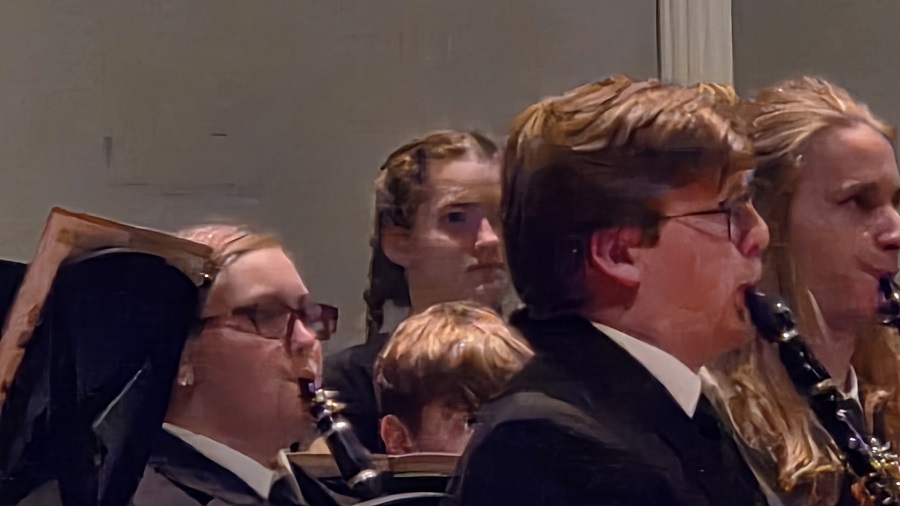
Mr. Eyrich: Well, I would say keeping the expectations very high and never back down on that. We talk a lot about tone in the band and playing with a good tone quality and that’s really where it starts. We focus a lot on tone and how to produce high-quality sounds on your instrument and make characteristic sounds. So if you’re playing a clarinet does it sound like a clarinet or does it sound like a kazoo?
I would say that it’s the high expectations and not taking anything less, because you don’t know what kids are capable of until you push them. And I think in many respects in public education, not necessarily Lemon Bay because we’re still the best high school in the county, but in many areas we are reducing the standards so that more people can meet them.
We talk a lot about how the standard in the band room is different than a standard in like a physics class, or a math class. If you’ve got two kids who are sitting next to each other and one earns a 100% on a test and the other one earns a 0%, the person that earned the A gets the A and the person that earned the 0 gets the F. Well, in band if you’ve got one person doing 100% work and one person doing 0% work then that averages out to an F.
It’s getting them to buy into the team mentality and saying, “Look, if we’re a band that’s doing C-work and getting a 70%, that means that 30% of the notes are being played wrong.” So, we really strive to do that A-level work.
I’ve got a sign on my door, and it says, “To those who enter, you’re subject to the unrelenting expectations of high-quality music,” or something like that. And once the students understand that that’s the expectation, they begin to push each other in a positive way, to say “Hey, we got to get this done, he’s not going to accept that quality of work.” I would say that’s the biggest thing.
ER: That’s so wise. People rise to the level of expectation.
Mr. Eyrich: Exactly, and none of this happens in a vacuum. None of this would be possible without the strong parent support, and we couldn’t do it without the support we’ve received over the years from the community, whether it’s folks attending our concerts or attending our fundraisers to help us go on great trips for the kids or afford instruments.
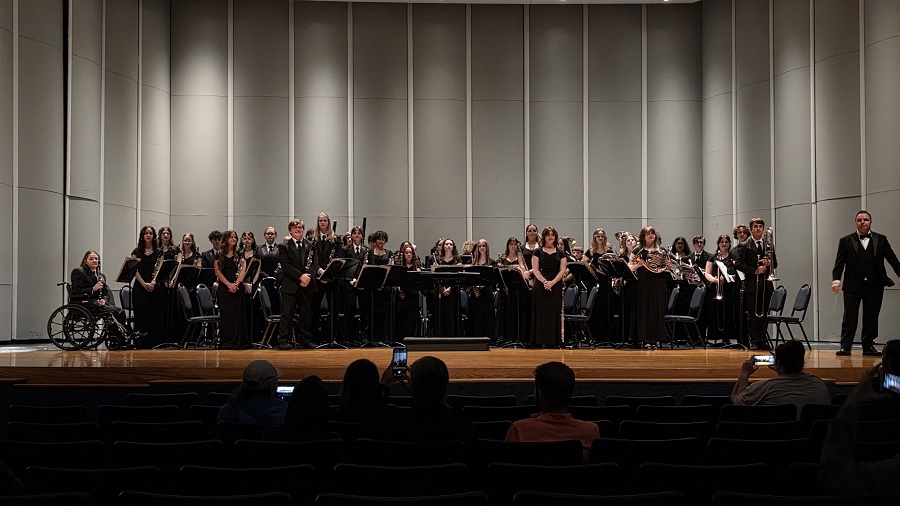
FAME was a big thing for many years and then we’ve got a good thing going with the Artist Colony over there on the Stage at the Park. I would say it’s really due to the community support and the support that the school at large enjoys that allows us to really support these students and maintain the quality of the programs. That’s huge and I know that’s going to continue because that’s who Englewood is.
ER: Thank you so much for your time, Mr. Eyrich, and please extend our congratulations to all your students on their tremendous success.
Mr. Eyrich: Thank you, I will.
So here’s to the musicians, the directors, the entire community and everyone at Lemon Bay High School who believes in these students and keeps this legacy alive. They’ve earned it.