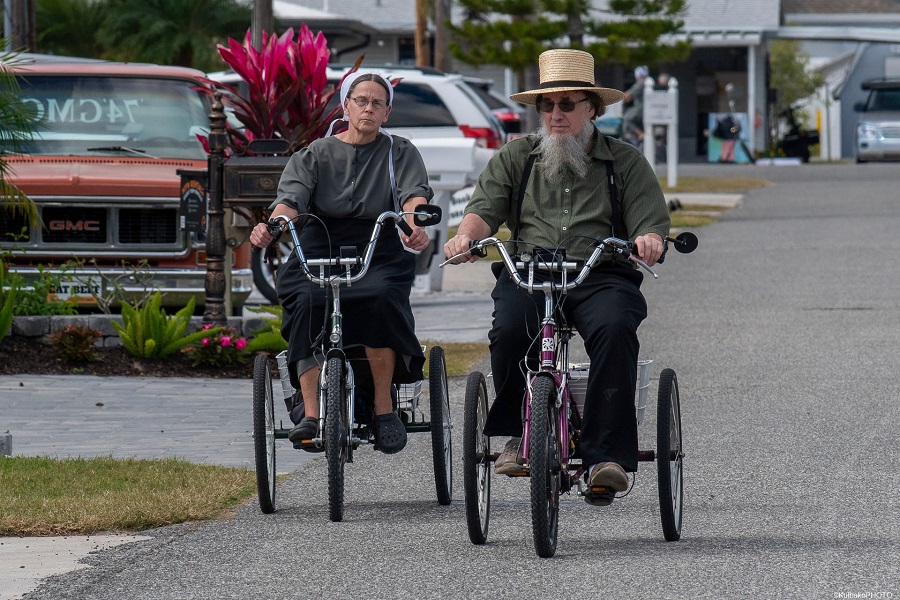
Pinecraft, Florida: picture Amish culture blending with the beach. Almost like imagining Sinatra and Snoop sharing a stage or eating pickles with ice cream. It doesn’t seem to go together. Yet, for five Amish teens from Ohio, Sarasota’s sun-drenched beaches felt like the ideal getaway, right in the middle of their Rumspringa.
Many people in the Englewood community may be surprised to learn that a quick 31-mile drive up the west coast of Florida, roughly 45 minutes, leads you to the heart of Amish country.
How Did Pinecraft Begin?
That first wild “Rumspringa-break” started it all, opening up a new direction for both Amish and Mennonite traditions down south. Back in the 1920s, five young men pooled their savings, bought a truck and some fishing gear, and hit the road heading toward the Gulf Coast. They found themselves hooked on fishing, loved the gentle winters, and when they got home, their stories about Sarasota spread fast. That enthusiasm pulled their dads into the adventure before long.
Think about it: if you’re a farmer who doesn’t keep dairy cows or livestock, winter can drag endlessly. The fields are quiet, there’s nothing growing, and you need something to break up the monotony. Sarasota’s Pinecraft became the retreat: warm weather, community, and a welcome escape from frigid winters.
Rumspringa
Not familiar with Rumspringa? Here’s the basic idea. Amish teenagers reach sixteen, and they get a window to step outside tradition, swap the horse-and-buggy for a chance to discover the outside world. “Rumspringa” literally means “jumping about.” It lasts until they choose to join the church, and though some come back in a year, others wander for longer, sometimes ten years.
Melanie Jones* knows these stories well. She’s a retired teacher, once a Mennonite herself, and she says the pull to belong runs deep. “I’d say about 95 percent of Amish teens who do Rumspringa return to the church. There’s a strong sense of community, a deep identity. People want to fit in.”
Her roots go way back. “That’s why everyone landed here,” Melanie says. “It started with tents—Amish people always live close to one another. But tents get cold. So, they built cement-block houses. The neighborhood grew. It covers ten square blocks now, with the community spilling out past Philippi Creek in every direction.”
She smiles, “Look at me—I hardly look Amish. But my grandmother and great-grandmother were Yoders. My great-grandfather? Nine kids. My grandmother, third in line, grew up Amish in Maryland until she married my Roman Catholic grandfather. My husband’s great-grandfather left the Amish church the day he bought a truck, back in the ‘20s.”
Melanie grew up in Pennsylvania, right where Amish culture is part of ordinary life. The tradition still matters a lot to her. “Both my husband and I have cousins who stayed Amish. We lived among it, always. And now we’re retired in Sarasota, which is honestly the only spot in the world where Amish go for a holiday.”
What happens in Pinecraft stays in Pinecraft
She has advice for visitors:
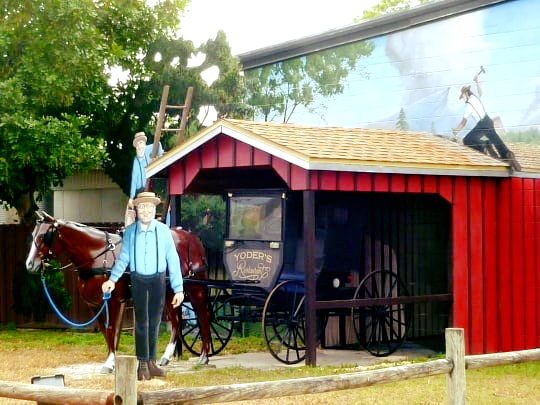
Tourist Tip #1: The Carlyle Inn is close to the heart of Pinecraft. The Inn and the Amish restaurant Der Dutchman are both run by Dutchman Hospitality, Inc.
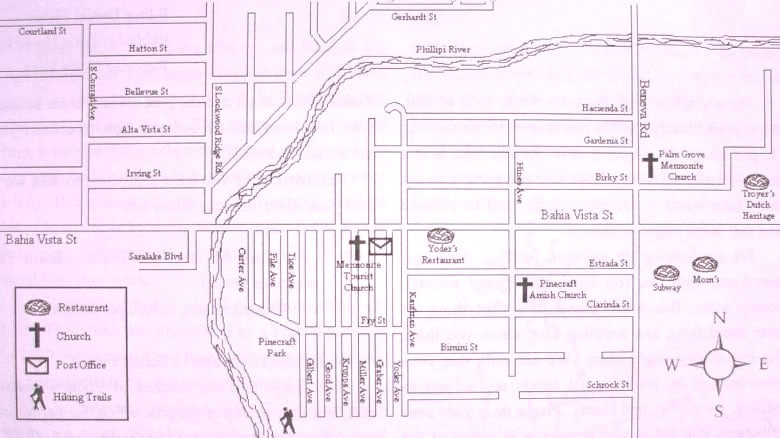
Pinecraft sits at Bahia Vista Street and Beneva Road in Sarasota, and every winter, Amish families from Ohio, Pennsylvania, and Indiana head here. The place is buzzing and still growing.
“It’s lively,” Melanie says. “If you strike up a conversation, you’ll see—we have more in common than you’d expect. Lots of shared values. Sure, some people judge, but every group has that, right? Baptists, Catholics, anyone.”
The media rarely gets it right. TV and movies paint Amish and Mennonites as standoffish, wary of outsiders. That’s not the reality. They stick to tradition, but they’re welcoming; they just respect the customs.
“They’re open to making friends. I wouldn’t walk up and start talking to a man, but I’d chat with a woman or a child. If she’s with her husband, I speak to her first. It’s just polite. I don’t want the husband to think I’m being pushy or showing off.”
Misunderstandings sting, for Melanie, too. “Our roots here run deep. I’ve known people in this community for years, and I don’t want Pinecraft to turn into Lancaster County—a spectacle for tourists. Respect the culture. Don’t treat it like something to gawk at.”
“If you take the time to listen, really try to understand, prejudice fades. Knowledge brings understanding, then acceptance. You don’t have to agree with everything. That’s not the point. I have deep respect for the culture I grew up with, and every now and then, I get to reconnect. Honestly, it feels like a privilege.”
Every year, the Amish look forward to their Florida getaway. Most of the folks who end up in Pinecraft are the ones willing to try something new. Right now, there’s a buzz in town, as sizable crowds roll in for the snowbird season. This is family time. Kids are out of school, so everyone travels together.
Now, how does a horse-and-buggy crowd get all the way to Sarasota?
They’ve solved that one. Each region runs a big express bus, running three times a week, straight from Lancaster. Aside from bathroom breaks and meals, it barely stops. Almost nonstop.
When the Lancaster bus finally arrives in Sarasota, it’s a sight. Hundreds gather weekly; some are welcoming friends, others are saying goodbye.
“Years ago, I used to roll my eyes at the crowds,” admits Melanie. “I figured folks were just being nosy. But after we retired and spent a month in Sarasota, I started to understand. One day at Publix, I glanced at my watch, texted my husband, ‘It’s 12:15. If I leave now, we can catch the bus pulling in at 12:30.’ The moment I pressed send, I realized I’d changed. Now I wanted to see who was stepping off the bus.”
Bus stations aren’t usually places people want to linger, but Pinecraft’s different. Imagine 200 friends and relatives crammed into a church parking lot, all eager to say hello.
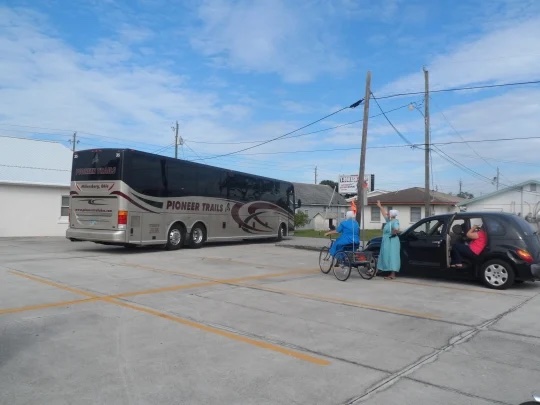
The season hits its peak right until Easter, when Pinecraft swells to almost 5,000 Amish and Mennonite visitors. The rest of the year? Maybe fifty.
Going home is a whole ritual. The schedule’s posted online and in the parking lot, and everybody knows when Ohio’s bus is arriving, or Pennsylvania’s is leaving. When it’s time to board, the crowd returns to wave goodbye to the fifty most miserable people in Sarasota. It’s heartbreak and sweetness packed into one.
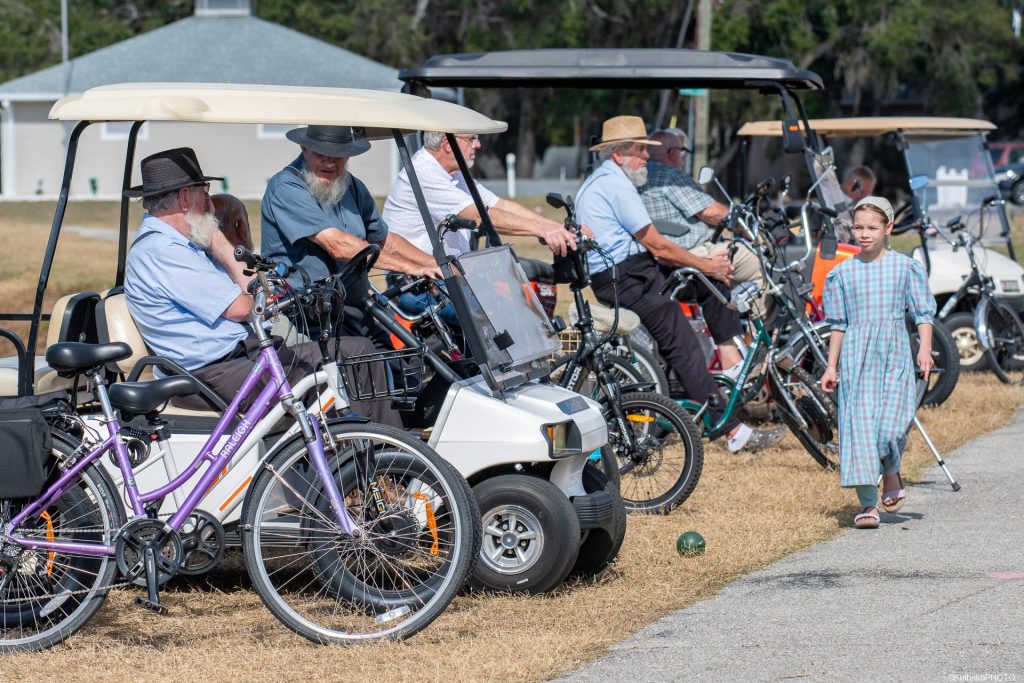
Tourist Tip #2: if you’re near the church around noon on Sunday, stick around. You’ll see lovely older couples spilling out in their black-and-white Sunday best. Grab your lunch and head to the park. Chat with the locals. You’ll enjoy it, and they’ll welcome you.
Maya Angelou had it right: “We are more alike, my friends, than we are unalike.”
Think about showing up at a party and realizing you and a friend wore the same outfit. Most people would laugh or rush home for something new. Not the Amish. Matching is the goal. Moms buy bolts of fabric, then make shirts for husbands and sons, and dresses for daughters. Everyone wears the same material.
Sometimes, Amish and Mennonite girlfriends decide to match, buying fabric together and sewing identical dresses. It’s not just a quirk. If you pay close attention, you’ll notice each community has its own details.
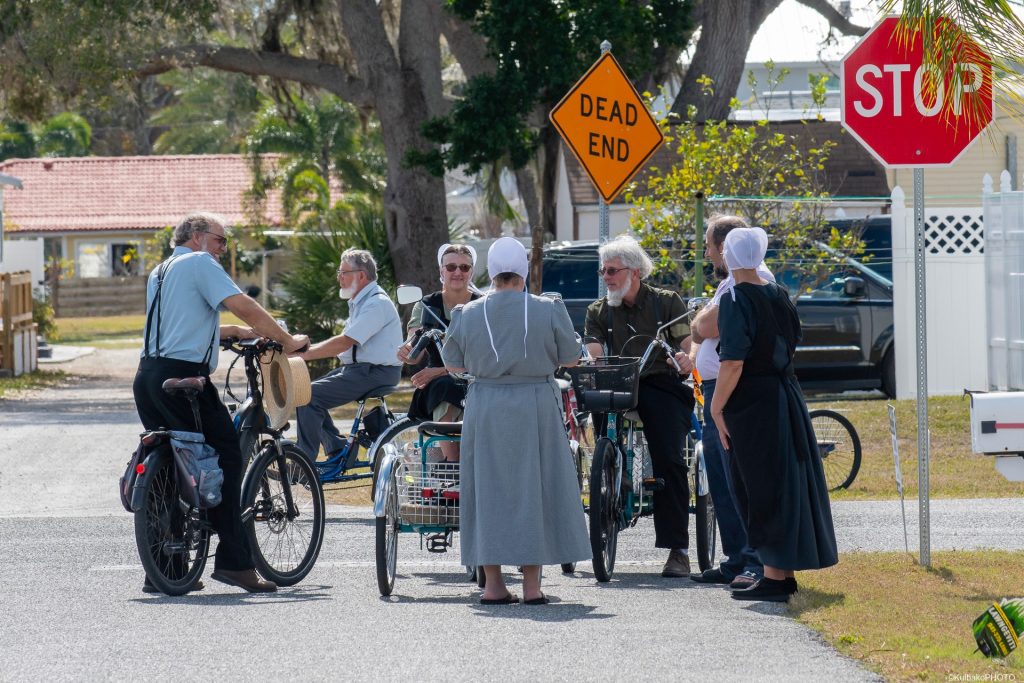
Walk through Pinecraft and you can spot Amish from Pennsylvania, central Ohio, northern Indiana, southern Indiana; each group stands out if you know where to look. The differences are subtle, mostly in their clothing.
Take hair. Pennsylvania women part their hair in the center and roll it back tightly. Over time, that creates a little bald spot where the pins go. Bonnets also give clues: Pennsylvania’s are heart-shaped from the back; Midwest bonnets are round like pillbox hats; Northern Indiana bonnets have pleats and a bow; Ohio’s are wider and rounder.
These customs, especially how they dress, link right back to scripture. Amish women never cut their hair because the Bible calls it a crown of glory. Why cut off your crown? Like plenty of other faiths, Judaism, Catholicism, the Amish keep their heads covered. There’s a verse in First Timothy about praying non-stop. If you’re talking to God all day, you cover your head. Simple.
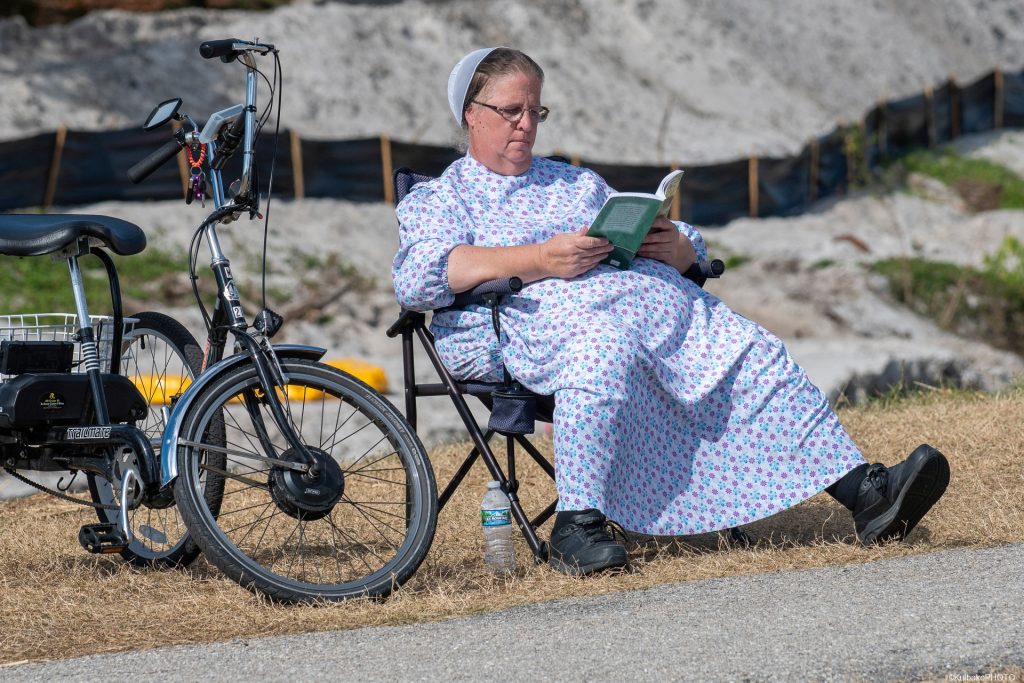
Everyone knows the rules: no zippers, no buttons, no snaps. Dresses cover elbows and knees; they stay loose. Cross the Florida border and things relax, though. In Florida, you spot Crocs, flip-flops, even bare feet in the garden.
Mennonite versus Amish
Sometimes, it feels like splitting hairs. Melanie explains, “Some Mennonites are super conservative; some look just like me. We worship at a Mennonite church in Florida, and not all Mennonites are alike. There are hundreds of groups, from strict to liberal.”
She says the Amish branched off from Mennonites, like Protestants split from Catholics. Cousins, more than strangers. “We get along fine. Here’s the rule: If you speak Dutch or German, you’re Amish. If not, you’re English. Doesn’t matter where you’re from—if you’re not Amish, you’re English.”
Why do the Amish do things their way? Melanie lays it out: “You don’t have to agree, but understanding helps. Know the reasons, and it just makes sense. Visit, and you’ll see we’re not so different after all.”
Look at the cracks in modern society. Plenty blame breakdowns in families. For the Amish, their rules come from the Bible, but it’s all about keeping the family strong.
Cars: they’re a big deal. “The nuclear family is central. Our sons are grown now, but if they needed something in town, with a car, they’d disappear for hours. With a horse, you brush, bridle, harness, back into the buggy. You can’t go more than ten miles, twenty all day. No quick errands.”
Amish families go to town together. “That’s why we don’t use cars. Not because we think cars are evil, but because they pull families apart.”
Sit in a restaurant today, and you’ll see people buried in phones. “No real conversation. What I love about my culture—even now—is the way we actually talk.”

That’s the heart of it: horse and buggy keep life slow and grounded; it helps you pay attention.
Amish folk speak the truth, but never swear oaths or place a hand on the Bible in court. “We’re patient, trustworthy. The Bible says, ‘Let your yes be yes and your no be no.’ No ‘So help me God.’ If I promise eight o’clock, I’ll be there.”
Imagine a world with no lawsuits. “The Bible says to talk it out privately, bring in church elders if needed. That’s how we handle disputes.”
No surprise: Amish don’t believe in divorce. “Marriage is forever. You can’t just take off a wedding ring or shave your beard when you’re in town. The beard is the wedding ring—everyone sees it. Divorce isn’t in the Amish community.”
Still, Amish marriages aren’t always easy. The church has changed. “Sometimes you just cope. About twenty-five years ago, folks started seeking counseling—it’s accepted now. Not every marriage is perfect, but there’s no remarriage after divorce.”
People misunderstand the photo thing. The Bible says not to make graven images. The Amish see posed photos as something that could become an idol. Don’t ask them to pose. Snap a candid while they’re working, and most won’t mind. You won’t see them posing. They don’t want to be an image or idol.
Tourist Tip #3: Big Olaf’s Ice Cream. Go for the treat, but half the fun’s in the line. Melanie swears by it. Waiting lets you hear stories, catch local buzz.
Check out the Carlisle Inn. Photos adorn the walls, featuring barn raisings, schoolhouses, and buggies. Melanie can tell a story about each photo.
One barn-raising photo stands out. An Amish man spoke up: “Our barn was struck by lightning and burned down the next day. An English crew cleared everything. That afternoon, 400 men and truckloads of lumber showed up. Eighty-two hours later, we were moving hay into the new loft.”
Melanie’s voice fills with emotion when she talks about it. The memory’s vivid. Another guest, a non-Amish guy, couldn’t believe it. “Eighty-two hours? I can’t even get a permit that fast. How?” The Amish wife just smiled. “That’s what we do.”
The Amish don’t buy insurance; they rely on each other. “You’re responsible for 20 percent,” Melanie says. “The community takes care of the rest.”
That’s not just barns or homes, it’s healthcare, too. Need surgery? A medical board of farmers negotiates a cash price. Each church group (about twenty-five families) has a little tin bucket. Folks pitch in. If there’s not enough, they ask neighboring churches.
The number of Amish kids on Rumspringa who decide to return surprised many. There’s a lot to love about that shared responsibility. Melanie knows it firsthand. When her tomatoes ripen, her mom, sisters, and aunts help her can them. Later, everyone goes to her mom’s house for round two. Weddings, babies, pickling, quilting, and the whole community pitches in.
Canning, quilting and pickles: community. In the end, Amish life and the beach might just be a better match than you’d think. Pickles and ice cream; not such a strange combination after all.
*Name changed upon request.