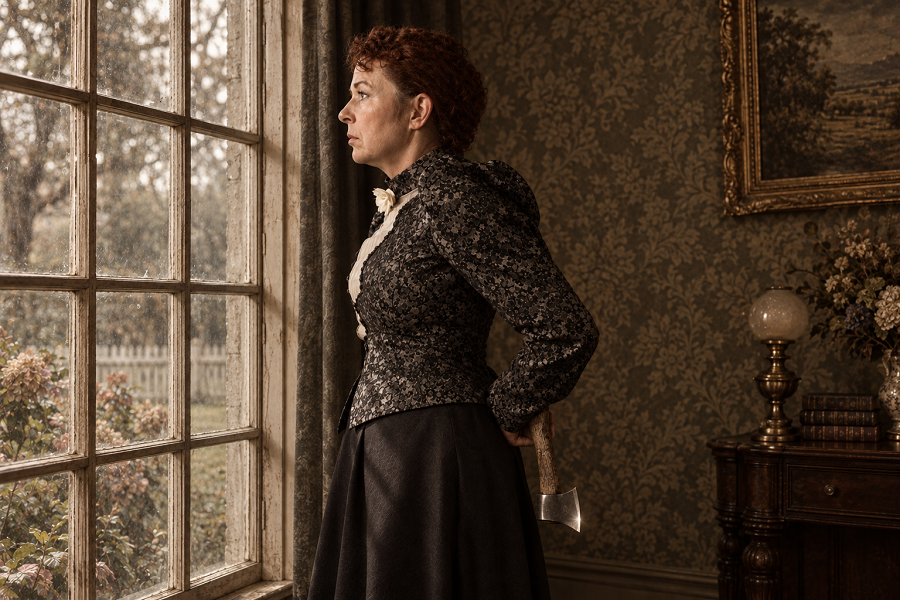
Did Lizzie Borden kill her father and stepmother? Over 130 years after Andrew and Abigail Borden’s murders, nobody knows for sure. But maybe the more compelling question isn’t whether Lizzie did it, but why she might have picked up the hatchet in the first place.
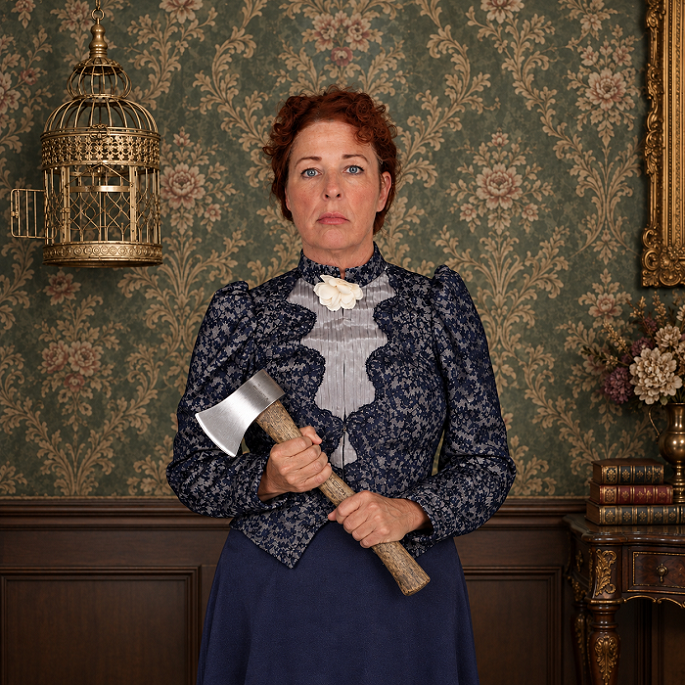
That’s the thread Venice Theatre pulls at in Sharon Pollock’s “Blood Relations.” This award-winning psychological drama, directed by Executive Director Kristofer Geddie, opens Friday, Oct. 9, in the Pinkerton Theatre and plays through Sunday, Nov. 1.
The timing is perfect. Lizzie Borden (played by Cheryl Andrews, back on the Venice stage after eight years) is suddenly back in the headlines thanks to the new Netflix series “Monster: The Lizzie Borden Story.” Ryan Murphy and Ian Brennan’s adaptation wades into grisly, fictional territory, but Pollock’s script smuggles its questions in through subtext. Instead of showing us the murders outright, “Blood Relations” lets its audience play detective, using a layered role-playing game to unravel Lizzie’s life without providing a neat answer about her guilt.
“In truth, I don’t care if Lizzie Borden swung the hatchet or not,” Geddie writes in his director’s note. “This play doesn’t either. Instead, the play and playwright ask something far more intriguing: What might it have felt like to walk around in Lizzie Borden’s shoes?”
Set ten years after the crime, “Blood Relations” finds Lizzie acquitted, trying to move past the infamy. One hot day in 1902, she welcomes a friend, an actress loosely inspired by Nance O’Neil (played by Venice Theatre regular Stacy Gilson), who wants answers about the murders. Lizzie sidesteps every direct question, instead inviting her friend to join a role-playing exercise.
The actress becomes the younger Lizzie, drawing on details provided by Lizzie herself, and piecing together her own narrative. Lizzie, meanwhile, slips into the role of Bridget, the Borden family’s maid, supposedly a mere bystander the day of the killings. Together, they revisit those pivotal events, with other figures from Lizzie’s world drifting in and out. As reality blurs, memory bleeds into imagination, making it tougher with each scene to tell what’s real and what’s invention.
This innovative structure lets Pollock ask bigger questions: How did the stifling pressure of Victorian womanhood and constant scrutiny close in on Lizzie? What pushes someone toward violence? “Blood Relations” isn’t just playing Clue. It’s asking what you do when you’re trapped in a life you never chose, and what it really means to take control of your own story.
“What begins as a murder mystery becomes something much more,” Geddie says. “It asks what happens when the life the world has chosen for you becomes unbearable. What happens when you’re trapped? ‘Blood Relations’ examines whether we can truly trust memory. It asks who gets to tell our stories, and what happens when someone else decides who we are.”
For Geddie, digging through old headlines turned up more than just grim details. “The deeper I dug into the people who inhabited that house—the Borden family, Bridget Sullivan, John Morse, and the others surrounding Lizzie—the less they felt like characters from an American legend and the more they became complicated, flawed human beings trapped by family, money, gender, sexuality, class, expectation, and secrets,” he says. “They are all of us.”
Sharon Pollock’s fascination with Lizzie Borden goes way back; her first attempt, “My Name is Lisbeth,” appeared in 1976 with Pollock herself taking the lead. She later reworked it into “Blood Relations,” which premiered professionally in Edmonton, Alberta, in 1980. The play scooped up the Governor General’s Award for Drama in 1981 and played to audiences across Canada and beyond.
Pollock became one of Canada’s leading playwrights, winning major honors like the Governor General’s Literary Award for “Doc” and the Gwen Pharis Ringwood Drama Award three times. In 2012, Canada recognized her lifetime achievements with the Order of Canada. She died in Calgary in 2021, but her questions live on in plays like “Blood Relations.”
Audience members who stick around after the 2 p.m. matinee on Sunday, Oct. 25, can join a talk-back with the cast and creative team, dig into “Blood Relations,” the Borden murders, or whatever theories you bring with you.
“Blood Relations” runs Tuesday through Saturday at 7:30 p.m., with Sunday performances at 2 p.m. All shows are at the Pinkerton Theatre, Venice Theatre, 140 Tampa Ave. W., Venice. There’s even a Halloween night performance (7:30 p.m. Saturday, Oct. 31) for anyone who wants to immerse themselves in true crime on a suitably eerie night.
At the end of the night, Pollock doesn’t hand you a solved case. “Blood Relations” invites you to sift through the evidence, walk inside Lizzie’s world, and reach your own verdict.
As Geddie says: “Watch closely. Listen carefully. Decide what you believe. Come along for the ride!”
Tom and Shelley Devine of Devine’s Wine Bar and Karen Kelly are this year’s sponsors.
Get tickets or more information at VeniceTheatre.org or call the box office at 941-488-1115.