Exploring Don Pedro and Protecting the Places We Love
Englewood and Southwest Florida offer some of the most beautiful paddle-only waters in the state, but keeping them pristine takes all of us.
A Favorite Launch: Don Pedro Island State Park
We are lucky to have so many beautiful places to kayak around Englewood and Southwest Florida. Paddle craft can only access many of these spots in these shallow back bays off the ICW.
One of our favorites is Don Pedro State Park. It’s a little over 6 miles south on Placida Road from the intersection with 776. There is plenty of parking with restrooms and a kayak wash-down area available.
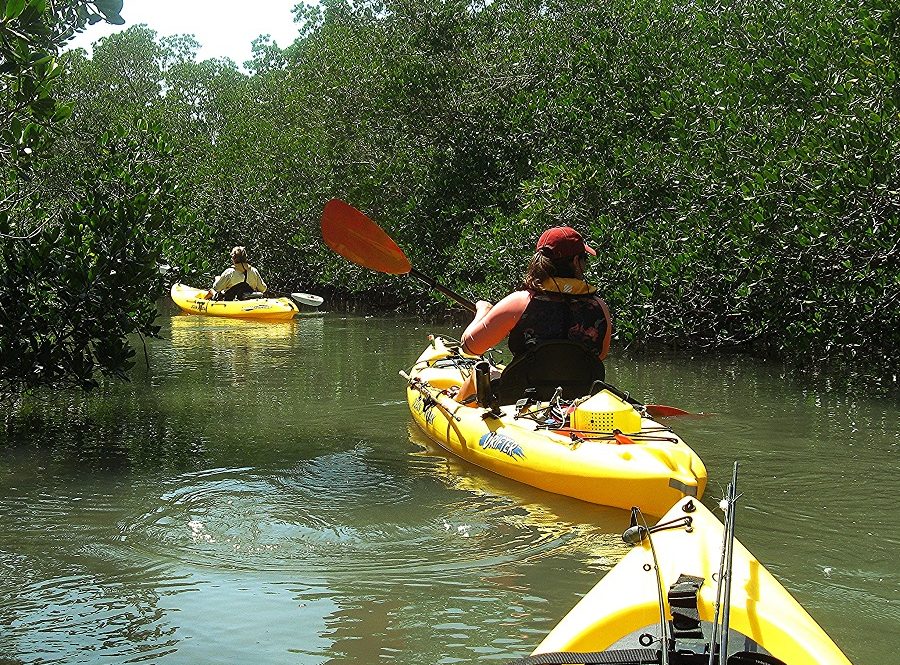
The most important piece of equipment to remember at Don Pedro is your dolly. It’s eight hundred feet from the parking lot to the water. A dolly that packs onboard your kayak will save you a few extra trips to stow it in the car. This launch is directly on the ICW in a minimum wake zone, so boaters should slow down but be careful of wakes when launching and returning. A mangrove tunnel leading to a hidden lagoon starts about 400’ south of the southernmost dock across from the launch area. It’s best paddled on a higher tide, but the lagoon at the end is a treat.
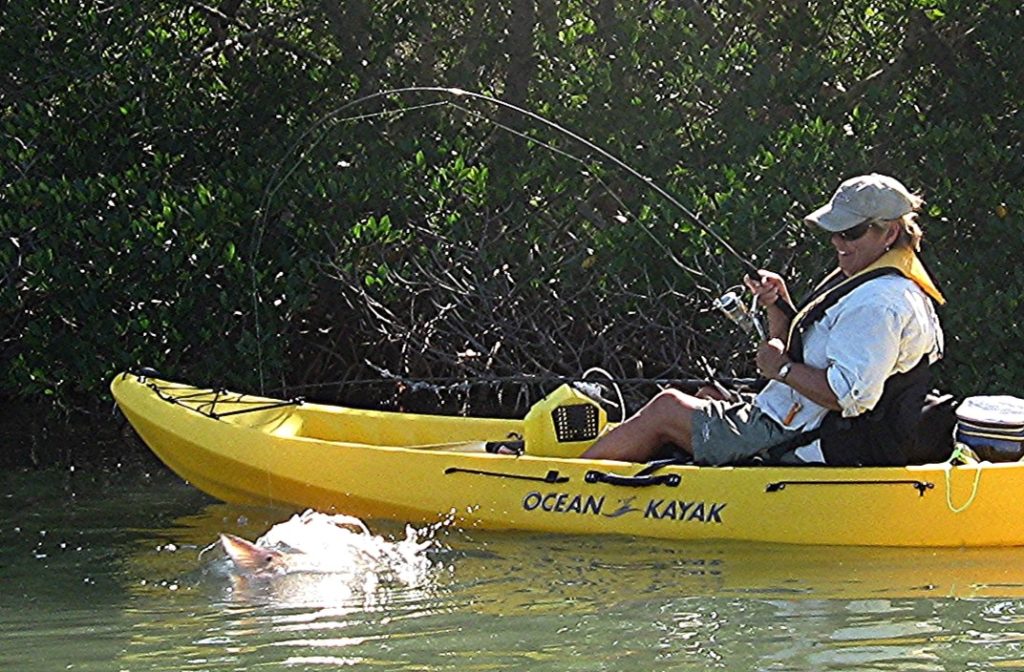
For kayak anglers, the good fishing starts right across the ICW on a grass flat that holds trout and lots of other species that stop by for a snack as they cruise the waterway. We have caught pompano, redfish, mackerel, and jack crevalle here. From here we usually paddle south to Rambler’s Hole while fishing the mangroves and channel edges along the way. Crossing into Rambler’s Hole under the collapsed bridge puts us on another good grass flat with deeper channels along the mangroves here. The last time we fished here, trout and ladyfish were thick, but so were the dolphins. To release the fish without the dolphins noticing in this shallow water required good timing.
In places like this, we usually tie on either a 1/16 – ounce jig with a natural-color shad tail or a DOA shrimp in either clear or red fleck color. In clear, shallow water like this, we tie two feet of 20 lb. fluorocarbon leader between our 10 lb. braid and the lure. Hurricane Ian destroyed the boat docks on the western shore of Rambler’s Hole and the trail over to the beach. There are other bays further south where folks can park a kayak and cross to the beach. Use caution here because the beach still has hazards, such as boards with nails pointing up.
As responsible kayakers, we try to leave our favorite spots better than we found them each time we visit. Not only do we pick up litter around the launches but also along the mangrove shorelines we fish. Whatever is lost from a boat or blown into the water ends up in the mangroves. A high tide floats things in, and they hang in the branches when the tide drops. We noticed this after Ian when there were so many white plastic bags hanging in the trees it looked like a rookery from a distance.
Items like pieces of docks and boats are impossible for us to deal with, but plastic bottles, cans, and other trash will easily fit in our kayaks out of the way. Fishing line, particularly braid, is a problem when abandoned in the mangroves. Monofilament decomposes quickly compared to braid, which may keep killing for decades. We commonly find 50 lb. braid strung for several hundred feet along mangrove shorelines. Removing it is difficult when it tangles among the branches and roots, and it keeps killing birds and fish. Our best plan has been to cut the line between the branches and haul off the pieces. Hooks left dangling from these lines with a fish attached will draw scavengers who will themselves become hooked and start the cycle again.
We hope by sharing some of our favorite spots we can persuade more kayakers to help pack out some trash to keep these spots as pristine as possible as usage increases. As for our fellow kayak anglers, we hope you will limit your kill rather than kill your limit. A quality game fish is more fun to catch twice than to eat once.
This story is contributed by Shore & Kayak Fishing, by Kimball and Les Beery.