On August 12, 2026, the moon’s shadow will sweep across Earth, setting the stage for a total solar eclipse. The path of totality, the narrow zone where day briefly turns to night, cuts across Greenland, Iceland, northern Spain, and a sliver of Portugal. Outside this narrow corridor, a much larger region, including parts of Canada and the northern United States, will see the moon nibble at the sun in a partial eclipse.
If you’re in Southwest Florida, you’re out of luck for this one. The eclipse peaks at 1:47 p.m. EST, but nobody down here will see even a sliver. Only the far northern parts of the U.S. and the Northeast catch the partial show, while the total eclipse runs over Greenland, Iceland, and Spain. For those missing out, NASA will broadcast the spectacle online; just visit the NASA Science Eclipse Page (link at the end of the story).
Let’s dig into where the eclipse will be visible, what makes totality so powerful, and how to watch safely.
What triggers a total solar eclipse?
A solar eclipse unfolds when the moon lines up between the sun and Earth, casting its shadow on us. Total solar eclipses happen thanks to a wild coincidence: Although the sun’s around 400 times wider than the moon, it’s also about 400 times farther away. This lets the moon, just occasionally, block out the entire sun and bathe us in darkness.
A spokesperson at the Robert Ferguson Observatory in California puts it simply: “The moon just barely manages to cover the sun from our viewpoint.”
So why isn’t there an eclipse every month? The moon’s orbit tilts about five degrees compared to Earth’s orbit around the sun, so they rarely line up perfectly; Sometimes, though, the geometry is right and we get a partial or total eclipse.
There’s another twist: The moon’s orbit is an ellipse, so its distance from Earth varies. When the moon’s farther away, it can’t quite cover the sun completely, even when it lines up. That’s when we get an annular eclipse, a glowing ring of fire encircling the dark moon.
Where can you see the August 2026 eclipse?
On August 12, the moon’s shadow will first touch down on remote parts of the Arctic, then trace a line over Greenland, Iceland, northern Russia, the Atlantic, Spain, and finally clip northwest Portugal. Totality begins around 4:58 p.m. UTC and ends about 6:34 p.m. UTC, with the deepest eclipse at 5:46 p.m. UTC. At the center, totality lasts up to two minutes and 18 seconds.
The sun’s height in the sky will vary along the path. In Iceland and Greenland, people will see totality high overhead late in the day. In Spain, totality brushes past right before sunset. This low sun makes the Spanish eclipse especially dramatic, but also harder to see if mountains, buildings, trees, or clouds crowd the horizon. You’ll need a clear view to the west.
Beyond the main path, much of the Northern Hemisphere gets a partial eclipse. In Alaska and northern Canada, it’s a morning event. Across the northern U.S. and eastern Canada, it hits midday or afternoon. Then, as night falls, Europe and western Africa catch the partial show.
Partial versus total: How different are they?
In a partial eclipse, the moon just takes a bite out of the sun. Even if 99 percent of the sun hides, the sky stays bright, and the faint solar corona remains invisible.
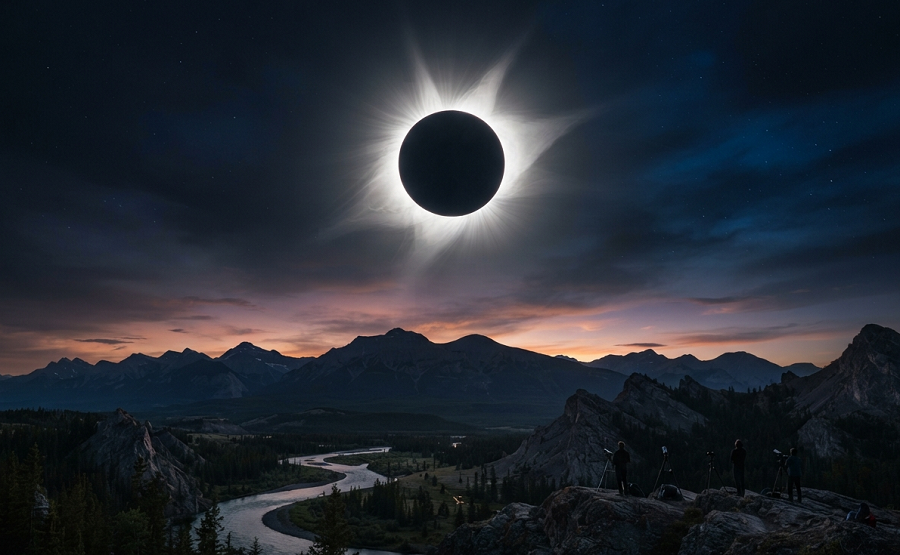
Totality changes everything. Daylight melts into an eerie twilight. The black disk of the moon sits in front of the sun, ringed by the corona’s ghostly glow. Animals notice, too: birds hush, then sing as if dawn has come again.
Are total eclipses really that rare?
In one sense, no, they happen somewhere on Earth about every 18 months. But the shadow’s path is narrow, often less than 70 miles wide. You need to be in the right place at the right time. For one fixed location, hundreds of years can pass between total eclipses. Welch points out that chasing eclipses can reward a traveler with several totalities in a single lifetime.
The next shot comes August 2, 2027, when the shadow crosses southern Europe, North Africa, and the Middle East. That eclipse brings a longer show, up to six minutes and 23 seconds of totality, almost three times as long as the 2026 eclipse.
What do scientists learn during eclipses?
Historically, eclipses were crucial. Early 1900s expeditions that tested Einstein’s theory of gravity by measuring starlight near the sun. Today, astronomers use eclipses to study the corona, its temperature, structure, and connection to the solar wind, since it becomes visible only when the moon covers the sun completely.
How do you see the eclipse for yourself?
First, use an eclipse map and get yourself inside the path of totality. Weather can make or break the show, so you’ll want to monitor forecasts and be willing to move on short notice. Photographers need to practice in advance, since totality flies by.
Never look straight at the sun without proper protection, and regular sunglasses won’t cut it. Use eclipse glasses or a certified handheld solar viewer. Remove your glasses only when the sun is completely covered within the path of totality. Put them back on immediately when daylight returns.
If you want to view the eclipse indirectly, something as simple as a pinhole projector works.
Above all, be present. Take time to simply look up and enjoy it. Totality lasts just a few minutes, but that memory will stay with you for the rest of your life.
Click here to view the eclipse live, as it happens with NASA.