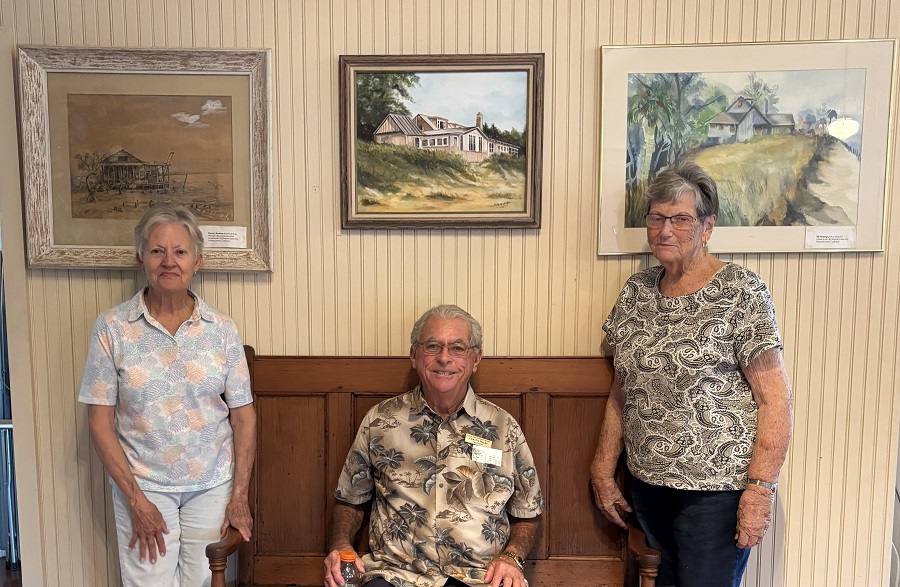
Recently, the Englewood REVIEW sat down with three leaders of the Lemon Bay Historical Society, Esther Horton, Nancy Wille and Charlie Hicks; all members of original pioneer families. They gathered to reflect on Englewood’s past, consider its present, and look ahead to the future.
Don’t even think about skipping this story just because you expect a dull list of dates and facts. Esther, Charlie, and Nancy are anything but boring. When they start talking about the wilder side of Englewood’s past, you can’t help but get drawn in. Honestly, between the three of them, there’s nothing they don’t know.
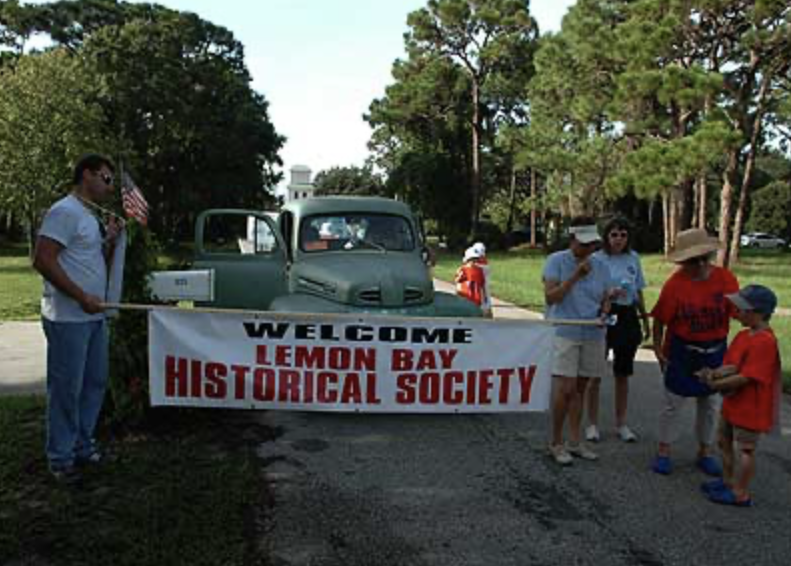
For seventy years, Pioneer Days has brought Englewood together in celebration. Here’s something you might not know: the Lemon Bay Historical Society began because of Pioneer Days.
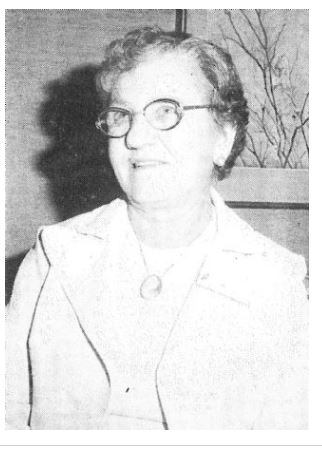
The spark came on September 4, 1983, when the community gathered to honor Josephine Cortes. She wasn’t just Englewood’s first newspaper editor; she wrote “The History of Early Englewood” and started Pioneer Days. Inspired by that event, residents met again in May 1984, determined to form a group focused on preserving local history.
They didn’t wait long to get involved. For the next Pioneer Days, on September 2, 1984, the society fired up a traditional mullet roast for 150 people, announcing themselves to the community in style. After these early efforts, the group officially incorporated as a non-profit in 1985, making their mission clear: to honor the area’s pioneers and keep Englewood’s story alive.
The conversation began by discussing a recent controversy: “Make Englewood Nude Again.”
ER: I understand the Englewood REVIEW’s article, “Make Englewood Nude Again”, which was inspired by Nancy and Esther’s hilarious presentation at the Smoked Mullet Awards, created some confusion. Let’s set the record straight once and for all: you’re not promoting making a nude beach in Englewood.
Esther: I have encountered several people who came away from the article with the idea that we were kind of in favor, and I said, “No, actually, somebody else came up with a very clever idea, and we’re in favor of selling the shirts because the profits are supposed to come to us and we need money to take care of this old place.” But we’re not promoting a nude beach.
ER: Yes. That is now clear.
Esther: We were just totally surprised when we read the article because we didn’t know that Jessica was going to do this. But we’re so appreciative to Jessica for going forward with the shirts, and we’re very grateful that she is willing to give us the profits. But no, we are not promoting a nude beach. (Esther laughs) I had a picture of my husband putting his head out of the window of the abandoned one that was in Cape Haze. So, if anybody wanted to go see it, “Where are they? Where are they? So, we can go look at them.”
ER: But there is a history of nudist colonies in this area, correct?
Nancy: Yes, at the Hermitage, that was the nudist colony. And I don’t know where the third one is, do you know?
Esther: There was one on Palm Island, right?
Nancy: Right.
Esther: I don’t know, off the top of my head, I could do a little research. But Nancy put together this wonderful presentation for the Smoked Mullet, and it covered a lot of history. But that was the one that ignited interest.
ER: And controversy.
Nancy: What do you think, Charlie?
Charlie: Well, let’s just see what happens.
ER: You say there were, in fact, not just one or two, but maybe even possibly three nude beaches.
Nancy: There were three.
Esther: Yeah, there were three.
ER: So, what happened?
Esther: I don’t know that we have that kind of information available. But back in the ‘20s, ‘30s, maybe even the ‘40s, Manasota Key was empty. It was almost deserted.
And when did the Chadwicks build the bridge? I can’t remember, but there was a while that the only way to get over to Manasota Key was to row your boat. And so, the population was very limited compared to today. You could walk up and down the beach just about any way you wanted to, and there was no one to object. Now, why nudist colonies are popular, I’m clueless. I have no background information.
Charlie: There was one that operated about 20 years ago down south of here. I forget exactly where it was. But I had a classmate who had a big home down there. We would go there to see her a lot. And one time, I wasn’t there, but they had a boat and they took a ride, and they went by this nudist colony.
Esther: I think that is the one that’s south that we’re talking about.
Charlie: Anyway, Barbara. She was a pretty loudmouth. They rowed by in the boat, she said, “Wow, look at the one on that guy!”
Esther: And I think that there are probably some nudist colonies still around.
Nancy: Yeah, there’s a nude beach in Lido Beach.
Esther: If you’re coming from on the shore, it’s the very end before Sarasota Pass. Now, there’s where the nudist colony is.
ER: See, I didn’t know that. And it’s still there?
Esther: I don’t know if it’s a colony.
ER: But it’s a nude beach.
Nancy: There is a nudist colony in Key West. I know that. That’s near Marathon.
ER: But this all started because of the colorful and entertaining programs that Nancy and Esther put together. I hear nothing but raves.
Esther: The historical items or events that Nancy puts in her programs, it’s a matter of reporting. It’s not that you’re necessarily in favor.
For example, there was a time when this was a hunting/gathering society and there were no stores; the locals would slaughter the loggerheads and make turtle soup. Now, we could talk about that in an event, about that’s what life was like. That doesn’t mean we are supporting anything like that. We are supporting “lights out for turtle season.”
ER: Yes, turtle soup was part of the historical culinary culture, out of necessity.
Nancy: But we’ll get into big trouble killing turtles.
ER: Of course.
Esther: There are a lot of things that we talk about in these reports. And it’s just a matter of history. It’s not that we are supporting it.
Their Earliest Englewood Memories
ER: We would love to hear about your memories of what Englewood was like back then?
Charlie: See, there were so few people here then. From South Venice to Charlotte Harbor, there was one facility where Englewood Road goes into 41. There’s a gas station, a food market, a fruit stand, vegetable stand. And from Englewood to Placida, there might have been 500 families.
ER: So, just nice and small.
Charlie: Yeah, it’s totally different to what it is now.
Esther: All the roads were two-lane. They weren’t marked. There were no white or yellow stripes on them. The bridges were wooden, and two-lane.
Charlie: There was no Pine Street.
Esther: Didn’t go through.
Charlie: And South Oxford, you could go through on it too, from south to north. But the biggest thing here was the Gulf Fishery down in Placida. And that road coming up, Placida Road, if it rained, you’d be very careful because those big heavy trucks loaded with fish and ice, they’d knock out those potholes. I hit one time, and it spun me around, flipped me over onto the other side of the road.
ER: Oh my gosh! What are some of the best things that you remember about growing up in this area?
Charlie: We were on Lemon Bay most of the time.
ER: How often did you get out on the water?
Nancy: All the time.
Charlie: Daily!
ER: Isn’t that wonderful? How about you, Esther? Did you get out on the water a lot?
Esther: Oh, yeah. Of course, my dad had a business, so it was like 9 to 5, six days a week.
Charlie: I worked for her dad.
ER: Oh, really?
Nancy: My dad had a boat charter and repair.
ER: (To Esther) And what did your dad do?
Esther: Grocery store. Mom and Pop. Before the corporates ran the Moms and Pops out of business.
Charlie: He was L.A. Ainger, and they have a school named after him. L.A. Ainger Middle School.
Nancy: That’s Esther.
ER: Oh, that’s you? What an honor to be sitting with the pioneer families of Englewood.
Esther: That’s my father. My father was L.A. Ainger.
ER: That’s great.
Esther: One of the things I remember growing up was that everybody knew everybody. And I think if anybody did anything that was out of line or unacceptable, the locals would have taken care of it. Because anywhere and everywhere we went, I felt comfortable with other families. Mom and Dad knew everybody, and I never felt that I would have been abused or anything like that.
Nancy: My dad had the boat shop repair, everything. And he had a pet store he rented, because you needed everything. But Dad was on the fire department, and if a fire came, Dad just left the shop wide open. Didn’t matter because no one was going to come in. He would just leave it and go to the fire.
Pool Hopping in Boca Grande
Esther: When we were kids, like in high school, we liked to go pool jumping. But there weren’t any swimming pools in Englewood, so you had to go over to Boca Grande.
ER: Oh, this sounds like a fun story.
Esther: The Boca Grande hotel, it’s still there. It was closed in the summer at that time. People didn’t come to Florida in the summer because there was no air conditioning. And so, their pool was locked down. The pool was over on the gulf side, and we broke in and got in the pool, a whole bunch of us kids. And was it Tom Knight? He was a cop on Boca Grande, Tom Knight. And he came by and caught us. And today, we’d have been arrested. But he told us, he said, “You all know you’re not supposed to be in here. You broke in, and get out and go home, or I will call your parents.” He said, “I’ll be back in 15 minutes, and you better be gone.” And so, the side joke was, 13 minutes later, we all got out and ran. But, I mean, we didn’t get in trouble.
Nancy: I have a picture of him getting a boat ready with an apparatus for if they had to go out in the bay to save somebody or anything. But he was helping Dad. This is just something Dad always said. Years ago, if you lost a $100 bill, it would get back to the owner by night. That just meaning that everybody was helping everybody.
Tin-Can Tourists
ER: When did the “snowbird” era begin?
Charlie: Down here on Old Englewood Road, they called them tin-can tourists.
Esther: They had them over on the beach too, where they would come down in trailers. There were a few people who would come down. My father had a grocery store, and this was back in the days before debit and credit cards. My father started a credit business for the fishermen on Boca Grande because if the fish hadn’t been running that week, they didn’t have any money to buy groceries. So, he would give them credit. And there were a few tourists who were down, and their Social Security checks hadn’t come through yet, and they needed food. So, my dad would give them credit. And then, when everybody got the money, they would come in and pay.
Nancy: And then the fishermen would come over by my dad to have the motors fixed, and they didn’t have the money. So, they had to come and bring it later or bring fish.
ER: Paying in fish, as currency?
Nancy: Oh, yeah. We ate a lot of mullet.
Charlie: I remember when your dad’s store burnt.
Esther: That was in ‘49.
Charlie: A relative of mine, he was my parents’ age. And he had credit there. He said, “Oh, I’ve got to go pay that credit.”
ER: That’s the first thing on his mind, that he wants to go over to pay his debt and help.
Esther: Right, that was wonderful. And my dad told the story, how people, after he got the store back up and running, how people would come in and say,” L.A., I know I owe you money, I don’t know how much, here’s a $20 bill,” which was a lot of money then. They did that kind of thing.
ER: And what was the name of his store?
Esther: It started out as Ainger Mercantile, an old wood-frame building. And then, when he built a concrete building, it became Super X because he joined a grocery chain.
Nancy: But Dad would say. “Go to Ainger’s and get this today.” That’s what everybody called it, Ainger’s. And Carol’s father owned the one on the other end of town, Tate’s Market.
ER: The competitor?
Nancy: No, they got along.
Esther: Friendly competitor.
Charlie: Yeah, but when it did burn, he called L.A. and said, “I’ve got enough in my store, I have a truck coming in, I’m going to send it over to you.”
Esther: Yeah. The community center, the building, it was a barracks building from the Venice airport. It was a military base in World War II, and there are barracks buildings all over town.
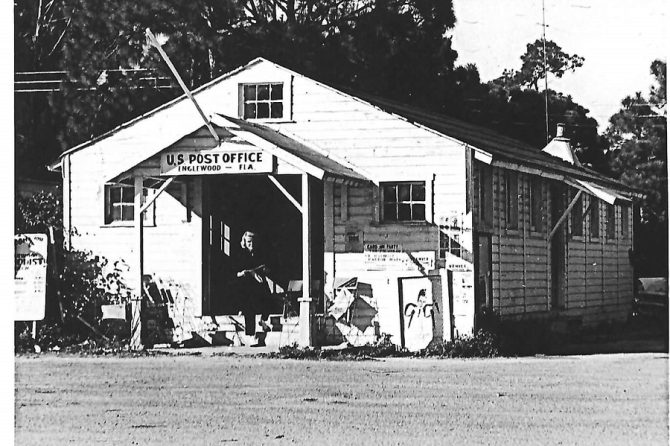
Charlie: Even the post office was in a barracks building down on Dearborn.
Esther: Cute, crazy story, and I’ll stop boring you. My dad, in front of the grocery store, he had one of those old pop-up Coca-Cola machines where you lift the lid, put in a quarter, and then you could work the bottle out.
Well, some of the kids like Junior Moder and Billy Davis and all of those, they figured out if you went in there with a bottle pop lifter, you could pop the cap off and use a straw and empty the bottle. So, I came home from school one day, and Junior was out sweeping the front sidewalk. And I asked my mom, I said, “What’s he doing?” “Well, he’s paying us back for the soft drinks he stole.” So, he got caught somewhere along the way. But isn’t that hilarious?
ER: So hilarious, and I love these stories of community; these stories of simpler times. We all miss them. But that’s why I think these stories are so important to share. The memories that you have of what Englewood was like back then, share those with me?
Charlie: Remember about 20, 25 years ago, River Road was a little two-lane. And you had to be careful because there were hogs all over the road. And now, I haven’t seen a hog out there in, I don’t know, I can’t remember the last time.
ER: Can you imagine if you weren’t in a car today and came across a hog?
Charlie: We moved out to East Englewood 14 years ago, and we had all kinds of animals coming through. And so finally my wife, she got these cameras and set them up so she could see the animals that would come through at night.
Now, we were going home, the day before yesterday I think it was, and coming down our street I said, “Look at that!” There were two raccoons, then two more little raccoons following right across the street. But in the vacant lots, there aren’t as many as there used to be.
ER: Nancy, what was the name of your father’s boat company?
Nancy: Scott’s Outboard Repair. Scott was the last name.
ER: (To Charlie) And you told me before about owning Stump Pass? Tell me a little bit about that.
Charlie: My father had a fish house down where the Stump Pass Marina is now. And my cousin a couple of years ago, we were at a get-together up in Lakeland, he says, “I learned a lot from your father.” He says, “When he’d come in, he’d see me down there waiting for him, and he’d just give a grin,” and so they’d get out and go fishing.
He asked, “what’s all that down there with all those slips of paper on the side of the fish house door?” He said, “Well, that’s people that come in. They weigh their fish and they put them in, and they ice them, and they put up there how many pounds they were.” And he says, “They never cheat on you?” He says, “No, that’s what you call integrity.”
He says he went through life using that same thing. And he was a big wheel with the unions up there in Ohio or something.
ER: I’m thoroughly enjoying this conversation. These stories are so important to share.
Charlie: I remember in the past, where we tried to bring up the old-timers, just like we’ve been talking, and it went over pretty well. We ought to do that again.
Esther: We’re running out of us.
Nancy: I wish you could just sit and look at the video with me that I got of the 1950s.
Esther: Yeah, we could do an old-timer’s presentation. We’ve got a couple of history events coming up in September and October. And I’ve got something for November.
Nancy: We have had them over the years, but we are all getting older, and it’s hard for all of us to keep going.
ER: Maybe pass the baton to people who are interested in history and preserving it. Is this center open? Can people come here?
Esther: We have not done that. We have not established that at this time.
Charlie: Well, we were talking about it, maybe during the season we could do that again.
Nancy: But we would like to have more members and get more involved.
ER: It seems like a perfect time for that, because, like you said, there’re hundreds of people honoring the history of Englewood, the spirit of Englewood.
Nancy: This is the attitude, though. “We just retired, so we’re not going to do anything. We got involved up north, and we don’t want to get involved down here,” but they want to be entertained, and we’re getting older trying to entertain them all the time.
ER: You are informative as well as entertaining.
Charlie: One of our problems is, if we have to vote on something, we have to have a certain percentage of the membership for it to pass. A lot of times we talk, it’s not very many, but a lot of times we don’t have that.
ER: You need more members, basically.
Charlie: Active members.
ER: What’s going to be your first kickoff thing when the season starts again? I mean, other than Pioneer Days.
Esther: Oh, well, our September program is going to be Sarasota History, presented by a member of the Sarasota County Historical Association. They’ll be coming down and doing it, and one of them is about the history of the county, and one of them is going to be the history of women in the county. So, that’ll be coming up.
ER: You have exciting plans. And then planning to have regular hours?
Esther: Well, nothing’s confirmed. I was president of the Lemon Bay Historical Society 30 years ago, and today we don’t have anybody who’s 50 years old. The younger people aren’t interested. And we have reached out to many people that we went to high school with, but who were grades behind us, and we’ve tried to reel them in. Nobody’s interested.
Nancy: When I do the programs, I can remember some of them sitting in, “Oh, I remember that we used to do that!” Well, come and join us!
Esther: Many times, we’ve been to the Buchan’s Fly-in, and we have offered a free membership to anybody who wanted to sign up.
ER: Oh, that’s wonderful. How much does a membership cost?
Esther: It’s $20 per person. It’s $35 for a couple.
ER: Yes. You’ve been an amazing organization, giving to the community for 43 years. And now, you’re recruiting members for the next generation. Is that the message?
Esther: Perfect.
Click here for more information about the Lemon Bay Historical Society.