
Another week, another Burmese python grabs headlines in Florida, except this time, the story comes with a twist and a clever plan.
In a state where contractors work nonstop to pull pythons out of the Everglades, the idea of releasing one seems almost reckless. Yet researchers do this on purpose. This isn’t a mistake; it’s how they find more snakes.
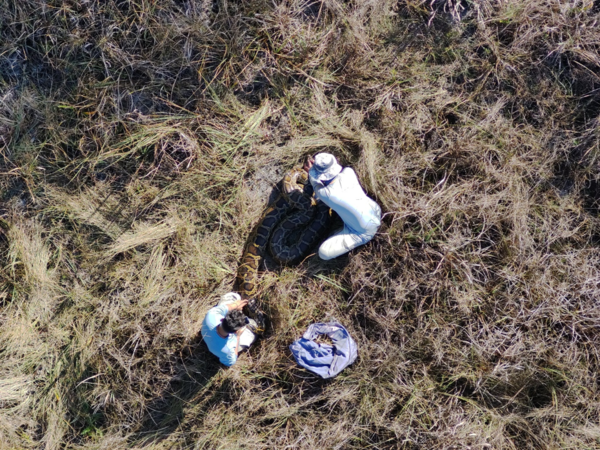
This python stretched 16 feet and tipped the scales at almost 148 pounds. Instead of meeting the usual fate, she got a radio transmitter, and interns from the University of Florida released her right back into the swamp. USGS biologists tracked her from above, piloting a drone over the thick grass.
So why let a giant, invasive snake go free? The USGS has a year-round “scout” program. Selected male and female pythons wear transmitters, and researchers from USGS and university interns track their movements. During breeding season, these “scouts” lead trackers right to clusters of other pythons and their nests. That’s where removal efforts do the most good.
Tracking isn’t easy. Researchers slog through sawgrass and swamp on foot, which eats up time and money. Drones change the game. They carry radio-tracking gear or cameras, and teams are testing them to see if they make detection faster and more efficient, cut down on labor, and help gather better data.
Florida needs every edge it can get. Burmese pythons invaded the region over the last forty years, now thriving across the Greater Everglades. Some grow beyond 17 feet. Females can lie up to 111 eggs in a batch.
The impact on wildlife is brutal. A 2012 PNAS study found that in the most remote parts of Everglades National Park, raccoon sightings dropped by 99.3 percent, and opossums by 98.9 percent compared to the 1990s. USGS links these snakes to the dramatic decline in mammals.
Removal efforts are massive. About 100 contractors hunt pythons year-round, and the state’s annual Python Challenge brings in over a thousand participants. Yet the most basic figure still escapes scientists. No one knows just how many pythons there are, as their camouflage is so effective that most go undetected.
As for the drones, their tracking abilities are still an open question. USGS hasn’t published concrete numbers on how many snakes aerial tracking helps find. For now, what matters is the data: a radio-tagged python, tracked from the air, reveals movements across places almost impossible for people to navigate.
Florida knows all too well how these stories begin. Australia’s rabbit plague started with just 24 rabbits released in 1859, and farmers in the U.S. once got paid to plant kudzu. This time, they released the animal on purpose to help fix the problem, not make it worse. Somewhere in the Everglades, a radio-tagged 16-foot python moves through the grass, and for once, researchers know exactly where she’s headed.
Click here for more information.