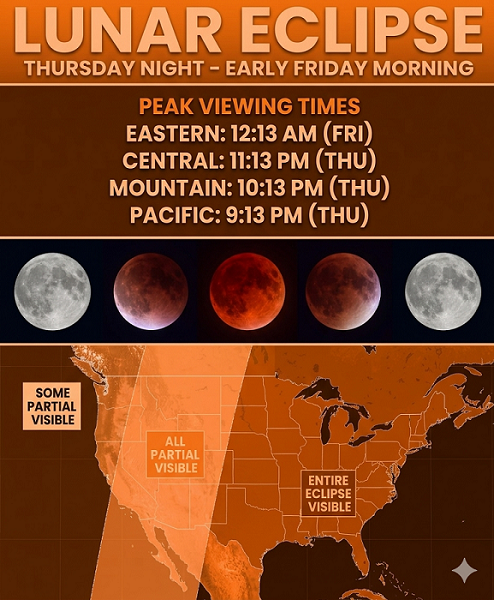
Circle Friday, August 28, 2026, on your calendar because this is a lunar eclipse you really don’t want to miss. From Thursday night into early Friday morning (August 27/28), almost the entire United States gets front-row seats to see 96% of the Moon’s visible disk slide into Earth’s shadow. That’s so close to a total eclipse, most of the Moon will glow a deep red, leaving behind just a thin slice of bright silver.
Here’s when you should look up:
Eastern: 12:13 a.m. (Friday)
Central: 11:13 p.m. (Thursday)
Mountain: 10:13 p.m. (Thursday)
Pacific: 9:13 p.m. (Thursday)
All you need is clear skies, which is the only real wild card. Fingers crossed for pleasant weather! This eclipse will be the most stunning one visible from the U.S. until December 2028. Charge your camera batteries and pick a good spot because the show will be one to remember.
For Southwest Florida, we’re in a prime location. We’ll see the entire eclipse, from start to finish.
Here’s what to expect:
9:23 p.m. (Thursday): The faint outer shadow (penumbra) touches the moon.
10:34 p.m.: The moon begins to slip into Earth’s darker umbra; the partial eclipse is underway.
12:12–12:14 a.m. (Friday): That’s the peak moment, when the moon looks coppery red, almost like a “blood moon,” except for a thin shining arc.
1:52 a.m.: The moon exits the earth’s shadow and wraps up its big performance.
A few tips for enjoying the view in Southwest Florida:
— Skip the special gear. Lunar eclipses are safe to view with just your eyes, no glasses, no filters, no fuss.
— Get away from city lights. Urban glow will wash out the colors. For the richest red moon, head for darker places:
– Naples/Marco Island Beaches are perfect, as the open Gulf gives you an unobstructed horizon.
– The Everglades and Big Cypress mean pitch-black skies if you can drive inland.
– Sanibel and Captiva Islands offer splendid views with less light pollution than the mainland.
— Check the weather. Late August means unpredictable humidity and sudden summer storms. Use the National Weather Service for up-to-date radar, especially Tampa Bay/Ruskin or Miami.
— Binoculars or a small telescope makes the shadow line and lunar craters pop with detail, but they’re not required.
— Don’t forget the bug spray. Midnight in Florida? The mosquitoes are relentless, so arrive prepared.
Enjoy the eclipse and stay up late for a show that won’t come back for another two years.