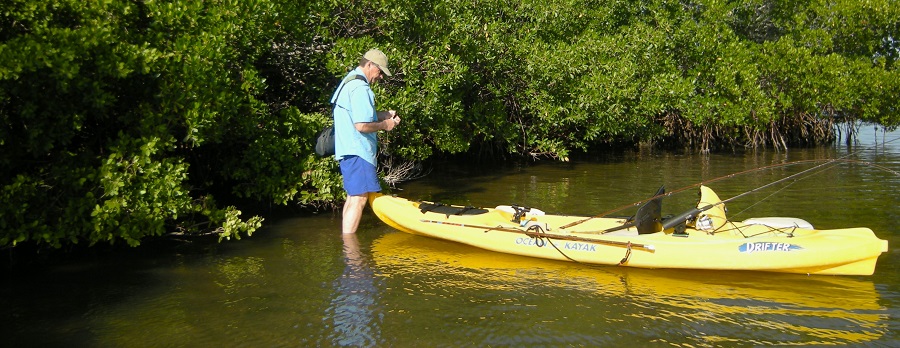
When a kayak angler is on the water, every minute not spent fishing feels like a missed opportunity. The quiet paddling, the wildlife, and the beauty of Southwest Florida are part of the joy; essential moments that help us unwind from life ashore. But the time lost re-rigging terminal tackle as we move from spot to spot is what we try to minimize.
Kayak anglers regularly transition between shallow flats, oyster bars, deeper grass beds, and channels. Each zone requires a different tackle, but a kayak offers limited space. Unlike bass tournament anglers who carry several rigged rods, kayak anglers must rely on a couple of versatile setups that adapt quickly and safely.
The Versatility of the Jig
Few pieces of terminal tackle offer more flexibility than the jig. It’s compact, effective, and safe, especially important in the tight quarters of a kayak. We discourage the use of multiple treble hook lures in our kayaks.
Shallow Water (6–24 inches)
A 1/16 oz jig head paired with a soft plastic tail allows for a slower retrieve, ideal for skinny water. With countless options for color, size, and action, a small box of jig heads and tails covers a wide range of situations.
For extreme shallows, switch to a weedless setup:
1/32 oz bullet weight
Wide-gap 1/0 hook
Rigged like a weedless bass worm
This lets you crawl a lure through grass and oyster edges without snagging.
Deeper Flats (3 feet and deeper)
Move up to 1/8 or 1/4 oz jig heads to reach the bottom. These heavier jigs fall faster on the pause, a motion that often triggers strikes as fish chase the bait into the grass.
Natural bait colors perform best. Our favorite DOA 3” shad tail colors include:
Rainbow Trout, Golden Shiner, Stark Naked, White, Clear, and Root Beer.
Jigs also shine when switching to bait. A shrimp or pinfish, chin-hooked on a jig head stays upright and looks natural on the bottom. Dragging a shrimp across sand holes has produced countless redfish for us.
If you bring two rods, make sure you rig one with a jig.
A Simple, Effective Live-Bait Rig
We often carry a few live shrimp and keep a second rod rigged for bait with:
2’ of 20 lb. fluorocarbon leader
1/0–2/0 live bait hook
Popping cork to maintain depth and keep the bait above the grass
Split shot for weight (various sizes)
A few swivels
A small split shot on the leader helps any bait get down quickly to keep birds from snatching it off the surface. Split shot also avoids the tangles common with sliding sinker rigs.
If you use a sliding sinker, give the line a pull after splashdown. This straightens the rig as it sinks and prevents most tangles.
If the shrimp run out, hook on a DOA shrimp and carry on.
Pack Light, Stay Ready
Kayak anglers aim to be ready for anything while carrying as little as possible. Re-rigging is sometimes unavoidable, but these two core setups dramatically reduce downtime.
A minimalist kit covers most situations:
- A handful of jig heads (1/16, 1/8, 1/4 oz)
- A baggie of soft plastic tails
- Small spool of fluorocarbon leader
- A few live-bait hooks
- Assorted split shot
- A few swivels
With these essentials, you’ll be prepared for nearly anything Southwest Florida throws at you while keeping your time focused on fishing, not fiddling with tackle.
Kimball and Les Beery, authors of Angler’s Guide to SHORE and KAYAK Fishing Southwest Florida, contribute these excerpts from both WATERPROOF books to promote the excellent fishing available in the Englewood area. They are available locally at Old Florida Gallery on West Dearborn, and for download at www.anglerpocketguides.com & amazon.com.