(Reporting by the Associated Press contributed to this story.)
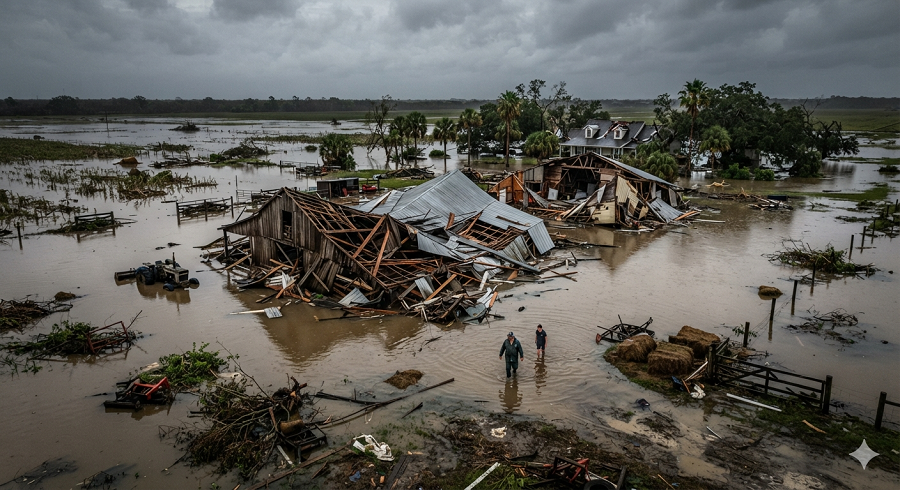
Jeffrey Huber still sees it clearly: one day there was a roof on his family’s house, and the next, Hurricane Andrew blew it into pieces. He was 12 when the Category 5 storm hit Florida in 1992, and his story is just one of thousands. For weeks, relief barely trickled in. His family counted on food donations for a month and a half. They spent a year living in a trailer.
The storm changed everything, not just the landscape, but how people thought about building in a world where disaster is the new normal. “It wasn’t just about the storm—it was the aftermath,” Huber says in an interview with the Associated Press. Speaking as a landscape architect and professor, he says, “Extreme events like this are getting more common. We have to design for what comes after.”
Nearly 40% of the country, about 129 million people, live in counties along the coast, where rising seas and stronger storms now tie into daily routines. New research links sea level rise directly to humans and tracks how flooding is getting worse, especially for cities clinging to the water’s edge.
In Florida, adaptation isn’t some buzzword; it’s everywhere. Designers and architects across the state are weaving climate resilience into buildings, parks, and even entire neighborhoods. Their goal: stand up to higher waters, relentless storms, saltwater sneaking into freshwater, and sizzling heat.
“In Miami, we deal with tidal flooding, storm surge, and slow, steady sea-level rise—all at once,” Huber says. “We can’t just keep trying to keep water out. The conversation now is about how we live with it, how we live above it.”
As the planet breaks temperature records, low-lying cities get hammered by floods. In Miami Beach, flooding became routine. Every time it rained, Anya Freeman had to race home to move her car, since the water swallowed the streets and rendered flood insurance impossible.
“No one was doing anything that would actually help,” she remembers. So, she left her job as a lawyer and launched Kind Designs, a company making 3D-printed, living seawalls. These walls aren’t just barriers; they’re affordable, they double as habitats, and they’re tailored to local ecosystems. On a summer day in Fort Lauderdale, workers in neon shirts installed a wall-shaped like mangrove roots, right outside a waterfront church.

Traditional seawalls are flat, dead concrete. Kind Designs builds theirs with grooves and hideouts for local wildlife, like mangroves in Miami or barnacles in New York. “We have a whole library of designs for different marine habitats,” Freeman says. “The goal is to bring in native species, give them shelter from predators, and break up the waves.”
It’s working. These living seawalls absorb 45% of incoming wave energy, making them far better at standing up to erosion and flooding. At one site, researchers counted 51 different species living in a wall just one year after it went in, including oysters and tubeworms that help clean the water. Freeman’s team has installed 16 of these seawalls in Florida for homes, businesses, and even city governments. They’re now expanding into California and New York and prepping to protect Navy bases along the coast.

Building for the Future, Not the Past
Drive around Miami Beach, and new buildings like the Vista Breeze senior housing project stand tall, literally. Brooks Scarpa Huber designed it to rise ten feet above sea level, ready for a storm surge up to 20 feet. The concrete, mixed with water-proof crystalline powder, stops water from creeping in and keeps the structure from corroding. Rebar gets a thick zinc coating for extra insurance.

“These are simple, cost-effective steps that make our buildings more resilient,” Huber says. “We can start making our homes stronger right now.”
They’re also thinking ahead about Miami’s sweltering heat. They lined up the buildings to catch the breeze and cool themselves naturally. Inside, you’ll find bright community spaces, open courtyards, and welcoming terraces, places to gather. To nudge people toward healthy habits, the building makes the stairs easy to find, hiding the elevators away.
Head about 30 miles north, and you’ll see an old parking lot turned into DC Alexander Park. Designers also incorporated flood management into the park. There’s a 25-foot overlook that gives shade, and a buffer of native forest soaking up runoff and saltwater, providing habitat and cooling the air. All this is straight out of Huber’s research on “salty urbanism,” as he describes in his latest design manual.
Testing and Expanding New Ideas
Miami is ground zero for all these strategies. “We’re working on designs that can handle five, even nine feet of sea level rise—that’s where other coastal cities are heading,” Huber says.
But none of this happens without big changes in policy, financing, and community support. Aaron DeMayo, an architectural designer and urban planner, started developing “The Coastline,” a master plan to defend South Florida from rising water. The price tag is steep, but DeMayo sees the urgency. “We’re talking about protecting hundreds of miles of waterfront property—the return on that investment is huge.”
Meanwhile, at the University of Miami’s Center for Urban and Community Design, director Thomas Klein is attacking a major gap: lower-income communities rarely get help to make their neighborhoods climate-ready. So, they’re building a fund to support community-driven, resilient projects, helping residents design infrastructure that truly reflects their needs.
Klein wants every project to serve more than one purpose. “By 2026, can we justify building roads that only move cars? Or should those same roads have bike lanes, rapid bus lanes, stormwater management, and ways to fight the heat?”
Later this year, they’ll start dreaming up “sponge parks,” green spaces designed to absorb rain and manage flooding. Florida’s tricky regulations make this hard, Klein admits, but that’s also what makes the solutions powerful. When you design for a tough environment with limited tools, the ideas you create end up being even more resilient, and other states are already watching.
In Florida, the ground is shifting beneath everyone’s feet, and the world is learning as the state adapts. The ideas taking root here may end up shaping how every coastal city faces the future.