
Shark Week 2026 kicks off on July 26. This summer, Discovery is back with the 38th year of wild shark action.
Starting Sunday, July 26, at 8 p.m. and running through Saturday, August 1, get set for 20 brand-new premieres that’ll keep you on the edge of your seat.

They’re starting strong. Comedian Ken Jeong teams up with GRAMMY®-nominated artist REI AMI in K-Pop Shark Heroes, a fresh take on shark conservation that uses the global power of K-Pop to reshape how people see sharks in East Asia and worldwide. After that, fan-favorite Air Jaws: Red, White and Breach returns with scientists on the hunt for legendary breaching great whites, and this time, they’re checking if these massive predators are making a splash in American waters.
Adventure host Josh Gates dives into history with Expedition Unknown: Shark Secrets, where he unpacks the world’s first recorded shark attack and ponders if a so-called sea monster was just a misunderstood shark. Then there’s Ultimate Shark Dive, cliff-diving pro Molly Carlson tries to break records plunging into shark-filled waters. It’s gutsy, dangerous, and you can’t look away.
Returning shark experts like Paul de Gelder, Forrest Galante, Dr. Tristan Guttridge, and more will push deeper, braver, and further than ever, exploring new mysteries lurking in the deep.
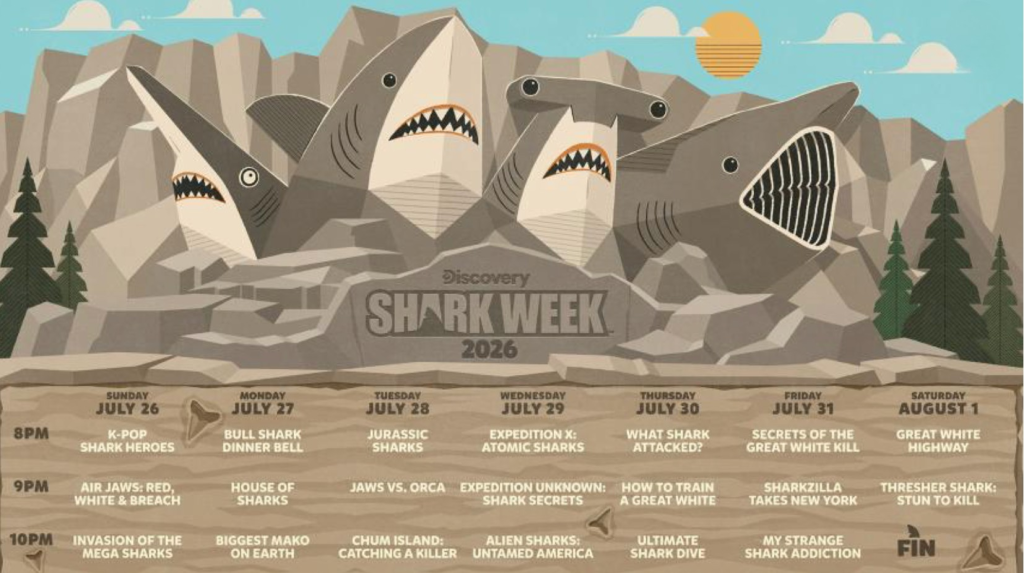
Want the full schedule? Here are all those details and a sneak peek of what’s coming during Shark Week.
A quick look at the 2026 highlights:
– Airs nightly at 8:00 PM, 9:00 p.m., and 10:00 p.m. ET/PT.
– K-Pop Shark Heroes: Ken Jeong and REI AMI champion shark protection in East Asia.
– Air Jaws: Red, White and Breach zeroes in on great whites off America’s coast.
– Chum Island: Catching a Killer has Dr. Riley Elliott tracking aggressive sharks off Australia.
– Ultimate Shark Dive with Molly Carlson promises a breathtaking leap into danger.
Some fast facts to impress your friends: sharks have been swimming the world’s oceans long before dinosaurs, some species can live for centuries, and, most importantly, Shark Week isn’t just about thrills. They’re out to set the record straight about these misunderstood predators and spotlight why we need to protect them.
More Fascinating Shark Trivia
Sharks have been around for hundreds of millions of years, and they’re some of the ocean’s weirdest wonders. Take the whale shark; it’s enormous. The Greenland shark? Basically, a living fossil. And the shortfin mako? It’s the speedster of the sea.
Let’s talk about their bodies.
Sharks don’t have hard bones like you and me. Their entire skeleton is cartilage, which is the bendy stuff in your ears and nose. As for their skin, it’s nothing like smooth dolphin skin. Touch a shark and you’ll notice it’s like sandpaper, thanks to all those tiny, tooth-shaped scales called dermal denticles. Then there are their teeth: sharks are tooth-making machines. Across a single lifetime, a shark can produce tens of thousands of teeth, always growing new ones to replace the old.
Now, the senses.
Sharks have a kind of sixth sense, literally. On their snouts, they’ve got these cool organs called the ampullae of Lorenzini, so they can pick up tiny electric pulses from hidden prey. Hammerhead sharks look strange for a reason: their oddly shaped heads give them nearly 360-degree vision. And their noses are no joke; some sharks can sniff out just a single drop of blood in a pool the size of an Olympic arena.
Some sharks push boundaries.
The whale shark gets as big as a bus but dines on microscopic plankton. Greenland sharks are in no rush; they can live up to 400 years. Meanwhile, shortfin makos blaze through water at 46 miles per hour, beating out most fish by a long shot.
Sharks aren’t just survivors; they’re record-breakers in almost every sense.
Don’t miss what’s sure to be the wildest, sharpest Shark Week yet.
Click here for more information on Discovery’s Shark Week.