Tropical Storm Dolly has just formed in the Atlantic, making it the fourth named storm of the 2026 hurricane season. Right now, forecasters see it as a short-lived storm.
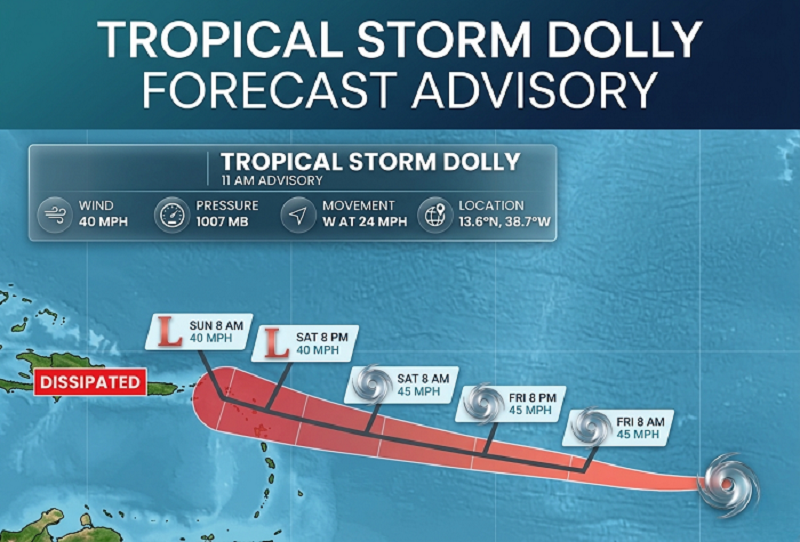
Dolly sprang up thanks to a brief stretch of favorable weather, but those conditions are already fading. As it heads toward the weekend, the storm will meet drier air and stronger winds, conditions that make it tough for tropical systems to survive. The National Hurricane Center predicts Dolly will drift into the Caribbean and then break apart soon after.
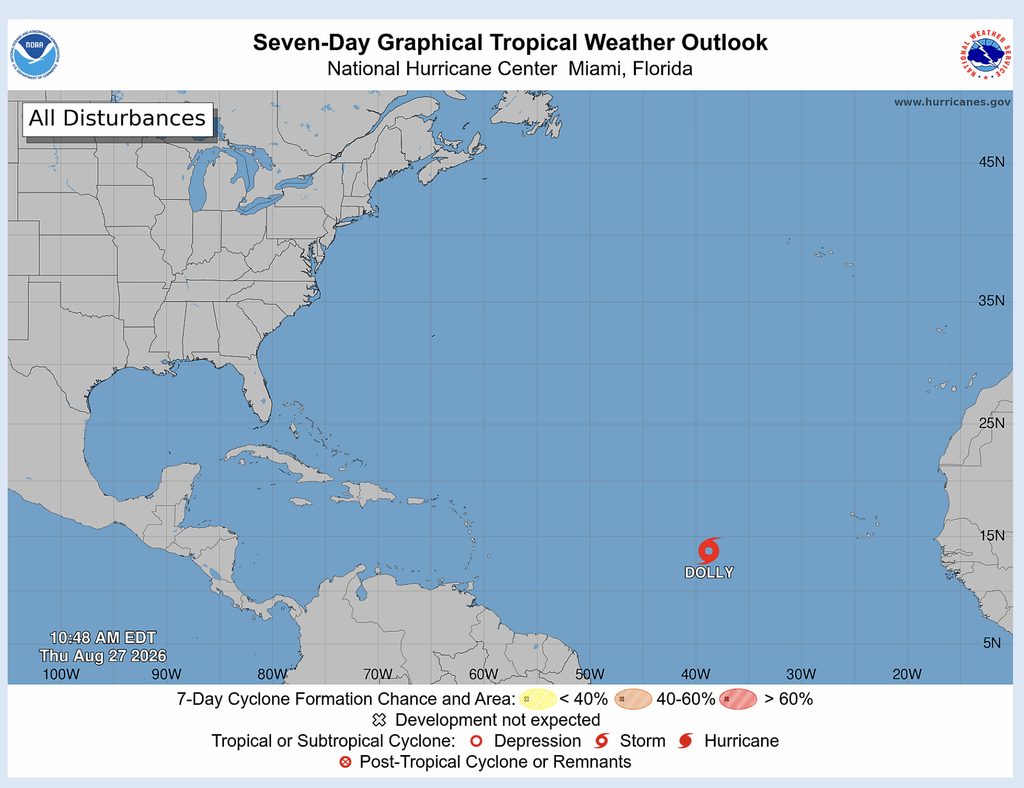
Earlier in the week, models showed two tracks. One path had Dolly strengthening and turning north, away from land. The other showed a weaker system tracking west. Now, most forecast models agree on the western path. If Dolly continues west, it could bring heavy rain to the Caribbean islands, starting with the Leeward Islands and Puerto Rico by Sunday or Monday, then possibly reaching Hispaniola after that. Beyond those points, Bahamas, Cuba, even the U.S.; there’s uncertainty. Some models suggest that even if Dolly falls apart, leftover moisture could try to regroup over warmer waters later. That’s not a sure thing, but it’s something to watch.
Best-case scenario: Dolly fizzles out and just brings some rain. There’s no need for alarm right now; consider this an early heads-up, not a warning.
As of Thursday, Dolly was located roughly 1,555 miles (2,500 kilometers) east of the Leeward Islands, carrying maximum sustained winds of 40 mph (64 kph) and moving west. There are no watches or warnings in effect so far, but forecasters say the Leeward Islands could see heavy rain Saturday and Sunday, with more rain possible for the Virgin Islands, Puerto Rico, and Hispaniola through Monday.
Forecasters don’t expect Dolly to get much stronger in the next few days, but flash flooding could still be an issue.
For context, this hurricane season started with Arthur making landfall on the Gulf Coast in June, Bertha following in July with rain for Louisiana and Texas, and Cristobal quickly forming and fizzling in early August. The National Oceanic and Atmospheric Administration expects a quieter-than-average season this year, calling for eight to 14 named storms. Of those, three to six may become hurricanes, and only a few could grow into major hurricanes.
One last thing, there’s no connection between this storm’s name and Dolly Parton’s recent passing. The World Meteorological Organization names storms using pre-set alphabetical lists, cycling every six years.
Dolly is something we’re watching, but it’s not a problem right now. Stay tuned for updates.
Click here for more information at the NHC website.
This report reflects weather forecast information from August 27, 2026. The Englewood REVIEW will provide updates as conditions evolve.